Buying a home can be a daunting experience, especially when it comes to securing a loan. But with FHA home loans, you can breathe a sigh of relief.
These loans are backed by the government, which means the lending requirements are more relaxed compared to traditional loans. And with a low down payment of only 3.5%, homeownership is now within reach.
At The Mortgage Architects, we specialize in providing FHA loans. So, even if your credit score isn’t perfect, don’t worry! You may still be eligible for a higher loan amount with our relaxed minimum credit score and requirements.
Mortgage discount points are optional fees you pay at closing to receive a lower interest rate. One point costs 1% of the loan amount, but the rate reduction is not fixed—it depends on the lender, loan program and market pricing that day.
Paying points can make sense when the monthly savings recover the upfront cost before you expect to sell, refinance or pay off the loan. If you may move or refinance sooner, keeping the cash or choosing zero points may be the better decision. The right answer comes from comparing written loan options and calculating the break-even point.
Mortgage Discount Points: Quick Takeaways
One discount point equals 1% of the mortgage amount. On a $400,000 loan, one point costs $4,000.
Points lower the interest rate, but one point does not always reduce it by the same amount.
Break-even months equal the upfront cost of the points divided by the monthly principal-and-interest savings.
Compare zero-point and point options on the same day, for the same loan type and lock period.
How Do Mortgage Discount Points Work?
Mortgage points are a form of prepaid interest. You pay more at closing in exchange for a lower note rate and a smaller monthly principal-and-interest payment. Discount points are generally optional. They are different from other closing costs and from origination charges that compensate a lender or broker for arranging and processing the loan.
You can often buy a fraction of a point, such as 0.5 or 1.25 points. The price of a point is easy to calculate, but its effect on the mortgage rate varies. Market conditions, the loan program, property type, occupancy, credit profile and lender pricing can all change the result. That is why a blanket promise that one point always lowers the rate by 0.25 percentage points can be misleading.
Because points are fees tied to loan pricing, paying points can reduce the interest rate and lower monthly mortgage payments. Purchasing mortgage points should make financial sense for your timeline—not simply produce the lowest advertised mortgage interest rate.
Understanding how mortgage points work helps you avoid upfront fees that never break even. A fixed rate mortgage with points may lower your interest rate for the life of the loan, but higher monthly payments with zero points may save money if you refinance soon. The breakeven point should match how long you plan to keep the mortgage.
How Much Does One Discount Point Cost?
Multiply the loan amount by the number of points expressed as a percentage:
Loan amount × points percentage = cost of discount points
0.5 point on a $400,000 mortgage costs $2,000.
1 point on a $400,000 mortgage costs $4,000.
2 points on a $400,000 mortgage cost $8,000.
The cost is based on the loan amount, not the home’s purchase price. Points normally appear in the loan-cost section of the Loan Estimate so you can see both the fee and the interest rate associated with it.
Zero, One or Two Points: A Realistic Comparison
The following example compares three hypothetical 30-year fixed-rate options on a $400,000 loan. It assumes that each point lowers the rate by 0.25 percentage points. Actual pricing may be different, so use the table to understand the method—not as a current rate quote.
Option
Upfront point cost
Example rate
Monthly principal and interest
Monthly savings vs. zero points
Approximate break-even
Zero points
$0
6.75%
$2,594
—
Immediate
One point
$4,000
6.50%
$2,528
$66
About 61 months
Two points
$8,000
6.25%
$2,463
$131
About 61 months
These payments exclude property taxes, homeowners insurance, mortgage insurance and association dues. Those expenses do not change simply because you buy discount points.
How to Calculate the Break-Even Point
The break-even point tells you how long it takes for monthly savings to repay the upfront cost:
Cost of discount points ÷ monthly payment savings = months to break even
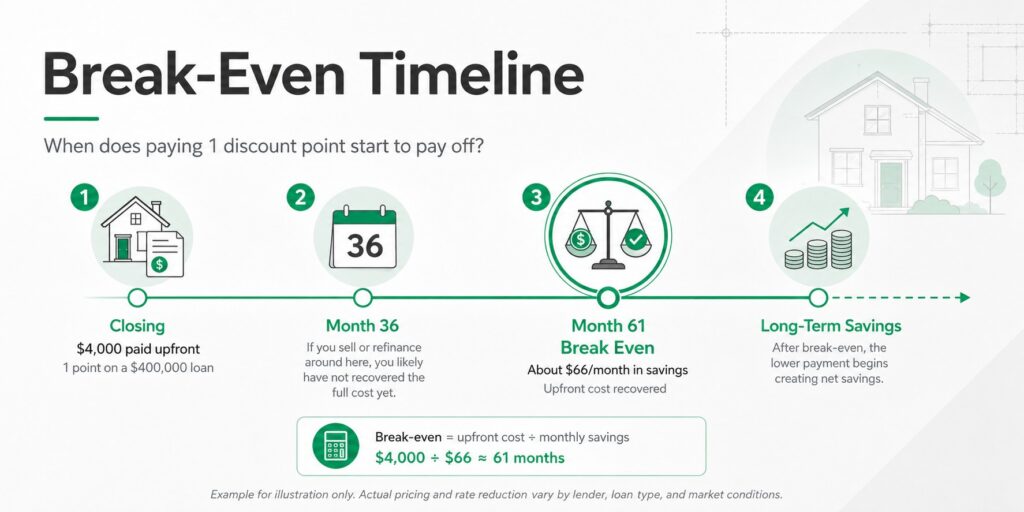
Using the one-point example above, divide the $4,000 cost by about $66 in monthly savings. The result is roughly 61 months, or just over five years. If you keep that exact mortgage longer than five years, the lower payment begins producing net savings after the break-even point. If you sell or refinance after three years, you would not recover the full cost through monthly savings.
Run the calculation with the actual rates and costs on your Loan Estimates. For additional payment scenarios, use The Mortgage Architects’ mortgage and refinance calculators. A calculator is a starting point; Nathan can compare the complete offers and explain what changes when the loan amount, term or point structure changes.
When Is Buying Mortgage Points Worth It?
Buying mortgage points may be worth considering when you have enough cash to cover the points without draining emergency savings, expect to keep the mortgage beyond the break-even date and value a lower required payment. Points may also help when a slightly lower rate is important to the long-term budget or to qualifying for the desired loan amount.
The strongest case usually combines a reasonable break-even period with a high likelihood that you will keep the loan. The weakest case is paying a large fee for a small rate reduction when you may move, refinance or pay off the mortgage soon.
When Zero Points May Be Better
You expect to sell or refinance before reaching the break-even point.
Cash is more valuable for the down payment, reserves, repairs or other closing costs.
The lender is offering an expensive point structure with limited monthly savings.
You are comparing an adjustable-rate loan or a short holding period where long-term savings are uncertain.
If you are considering changing an existing loan, read Nathan’s guide on when refinancing makes sense. A future refinance ends the savings from the old rate, so its timing belongs in today’s points decision.
Discount Points vs. Origination Points and Lender Credits
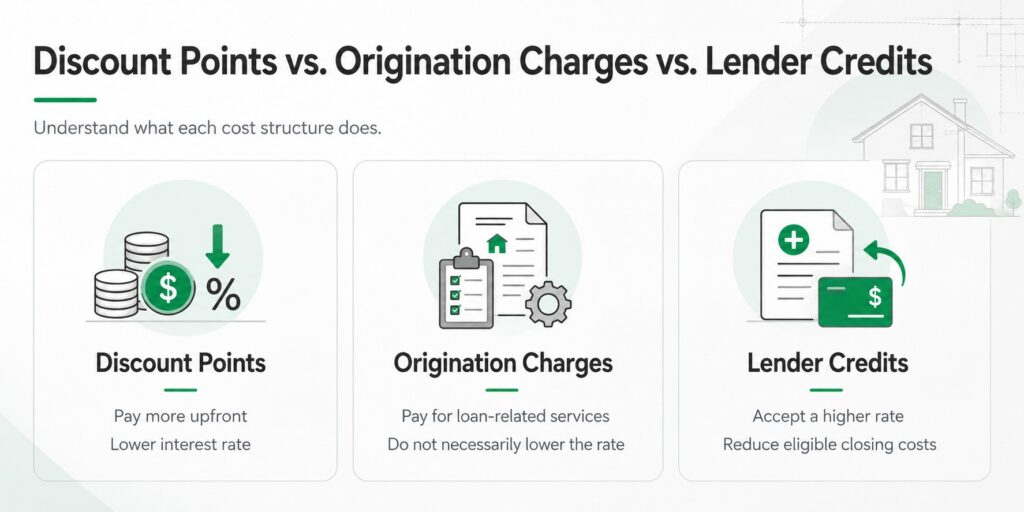
Discount points buy down the interest rate. Origination charges cover services involved in creating the loan; they do not necessarily reduce the rate. The word “point” can be used for either type of charge, so read the Loan Estimate carefully and ask what each fee accomplishes.
Lender credits work in the opposite direction from discount points. You accept a higher interest rate and receive a credit that can offset eligible closing costs. This is sometimes called negative points or a no-point option. It can be useful when minimizing cash at closing matters more than obtaining the lowest possible rate.
How to Compare Mortgage Offers With Points
Do not compare interest rates alone. Ask each lender or mortgage broker to price the same mortgage loan, loan amount, program, lock period and point level on the same day. Review the Loan Estimate for lender charges, origination fees and total loan costs. Then compare:
Interest rate and annual percentage rate (APR)
Dollar cost of discount points and origination charges
Monthly principal-and-interest payment
Total cash needed at closing
Five-year cost and break-even month
Whether a lender credit is included
A lower rate is not automatically the less expensive loan. The best option is the one that fits your expected timeline and financial priorities. A mortgage broker can compare pricing from multiple lenders and explain why one structure may be better for you. Learn more in our mortgage broker vs. bank guide.
Are Mortgage Discount Points Tax-Deductible?
Discount points may qualify as tax-deductible prepaid mortgage interest in some situations, but the timing and eligibility rules depend on how the loan and property are used. Purchase and refinance points may be treated differently. You generally must itemize deductions to receive a benefit. Internal Revenue Service rules can change, so keep your closing documents and ask a qualified tax advisor how the rules apply to you.
Frequently Asked Questions
What are discount points on a mortgage?
Discount points are optional closing fees paid to obtain a lower mortgage interest rate. One point costs 1% of the loan amount. The rate reduction attached to that point varies by lender and market conditions.
How much does one discount point lower the rate?
There is no guaranteed reduction. One point might lower a quoted rate by about 0.25 percentage points in some scenarios, but it can be more or less. Compare the lender’s zero-point and one-point quotes to see the actual tradeoff.
How are discount points calculated?
Multiply the mortgage amount by the points percentage. One point on a $300,000 loan costs $3,000; two points cost $6,000. Then divide that cost by the monthly savings to estimate the break-even period.
Can the seller pay discount points?
A seller may be able to contribute toward eligible closing costs, including discount points, subject to the loan program’s contribution limits and the terms of the purchase contract. Your loan officer can confirm the rules for your transaction.
Can I buy points when refinancing?
Yes, discount points may be available on a refinance. Include the points and all other closing costs in the break-even calculation. If you may refinance again or sell before recovering those costs, a lower-point option may be safer.
Are discount points the same as a down payment?
No. A down payment reduces the amount you borrow. Discount points are separate closing costs paid to lower the interest rate on that borrowed amount.
Get a Clear Points Comparison
There is no universally correct number of mortgage points. Nathan and The Mortgage Architects can compare zero-point, discount-point and lender-credit options across multiple lenders, calculate the break-even period and explain the tradeoffs without pressure. Schedule a consultation to review the numbers for your purchase or refinance.
Denver, the capital of Colorado, is a perfect place for young homebuyers to start their journey to finding a place to call home. With a thriving economy, scenic beauty, and diverse culture, Denver offers more than just a few hidden gems in its neighborhoods that will cater to any lifestyle.
Uptown
If you are looking for the ultimate destination for young professionals, look no further than Uptown! This vibrant and trendy neighborhood has a supply of dining options, boutiques, and coffee shops, making it the premier location for those looking for a day of good food and shopping. This area is also home to some of Denver’s oldest and most historic homes, which offers a charming and unique blend of old and new. Uptown has everything you need to satisfy your palate, featuring many of the city’s finest restaurants on Restaurant Row. Suppose you’re looking for some of the finest Italian cuisines. In that case, you’ll have to stop by Il Posto, where chef Andrea Frizzi serves up the most delicious northern Italian dishes using locally sourced ingredients. If you’re in the mood to cut loose and have some fun, the Uptown Tavern is a go-to for locals. This cozy location is a popular destination to find yourself in after a hard week’s work. They offer daily happy hours and a year-round rooftop patio to take in the views on any night. Uptown is also the perfect place to call home, with many apartment and loft options to consider. If you want to pamper yourself, the award-winning Castle Marne bed and breakfast offers the city’s only outdoor hot tubs atop the private balcony.
LoDo (Lower Downtown)
Lower Downtown Denver, better known by locals as LoDo, is an exciting neighborhood with a little something for everyone. This historic location is a perfect example of blending the modern with the old. Historic landmarks and modern construction blend perfectly to create a one-of-a-kind atmosphere and are a prime example of a Denver neighborhood that has gone through massive revitalization efforts and is a hub of activity. LoDo is a must for the food enthusiast, with over 70 restaurants and bars to visit. Whether you’re in for a romantic evening or ready for a night out with a friend, you’ll find plenty of options here. The nightlife in LoDo is second to none, with plenty of opportunities for socializing and entertainment. One of the biggest draws to LoDo is its proximity to some of the top attractions in Denver, including the Pepsi Center, Coors Field, and Ellich Gargend Amusement Park! Whether you’re a sports fan or just in the mood to enjoy a good show, you’ll find many options in this entertainment area.
Capitol Hill
One of the most unique neighborhoods located in the southeast of Denver’s Central Business District and close to the Colorado State Capitol is Capitol Hill. This area is known for a mix of rich cultures and personalities that make it an extraordinary place to call home. With a booming population, Capitol Hill is the perfect location for those who enjoy the vitality of a big city but also the charm of a tight-knit community. Capitol Hill is the location for artists and creatives, with numerous art galleries and music venues that showcase the imagination of local producers! This is another popular destination for food enthusiasts and craft beer connoisseurs. With close proximity to the State Capitol, it’s not unusual to witness Colorado’s political elite brokering deals over lunch in one of the various restaurants in the area. The biggest draw to Capitol Hill is its affordability. Despite being densely populated, this neighborhood is known to be one of the most affordable in the Denver metro area. Due partly to its excellent public transportation system, which makes getting around easy without relying on a car.
The Golden Triangle neighborhood in Denver is a dynamic and vibrant area near Uptown. This neighborhood is renowned for its architectural beauty, cultural attractions, and buzzing activity. Whether you’re a thespian, an art aficionado, or a foodie, the Golden Triangle has something for everyone. Home to the Denver Art Museum and Curious Theater Company, the Golden Triangle is the cultural destination of Denver. With a rich history and an unwavering dedication to the arts and cultural scene, this neighborhood is a destination for everyone. The Golden Triangle is also home to various entertainment options outside the theater and museum, including restaurants, music venues, bars, and more! The Golden Triangle is a unique destination because it is one of Denver’s oldest neighborhoods, filled with extraordinary Victorian homes and charming bungalows. Recent development has breathed new life into the area, bringing a modern feel to this historic neighborhood.
Cherry Creek
Located in the heart of Denver, Cherry Creek is a neighborhood that exclaims beauty, luxury, and accessibility. With its central location, Cherry Creek provides easy access to Denver with the city’s RTD bus routes. Within minutes you are brought to local shopping and dining destinations, with various options ranging from local boutiques to luxury brands. A diverse mix of housing options, including older and modern developments, gives Cherry Creek a unique sense of style. Cherry Creek is also home to an energetic dining scene, with many bars and restaurants that offer a wide range of atmospheres and cuisines. Cherry Creek has it all, whether you’re in the mood for a casual drink with friends or a fancy night out on the town.
There’s no doubt that Denver is a city with a multitude of diverse and exciting neighborhoods that offer a wide range of options for young homebuyers. Denver always satisfies you whether you’re looking for vibrant nightlife, cultural attractions, or a blend of modern and historic architecture. Each location offers a unique sense of charm and style, from the trendy Uptown neighborhood to the historic Golden Triangle. The affordable Capitol Hill and the luxury of Cherry Creek offer easy access to the city and an abundance of shopping and dining options. With these five hidden gems in Denver’s neighborhoods, young homebuyers can find the ideal place to call home. Get started today by visiting The Mortgage Architects
If you’re looking to move to an area that is a hub for culture and art, it’s no secret that the scene in Denver is exploding! With brand new galleries popping up all over the city, world-class art museums, an art district, street art, and art in public spaces, exploring the Mile High City’s artistic community is sure to be a vibrant and wild adventure! As you start your home shopping journey, a local mortgage broker can help you get pre-approved and find the best home loan.
The Art District on Sante Fe
First up, let’s start with Denver’s art districts! Just a stone’s throw away from the bustling city center, the Art District on Sante Fe is a melting pot of culture. This neighborhood offers a unique mix of American and Mexican art. This colorful district has over 40 art galleries. It is the home of the Museo de las Americas, which showcases a wide variety of contemporary and traditional art, photography, graphic art, sculptures, and mixed media. During First Friday and Second Saturdays on Sante Fe, galleries open their doors to the public, offering a spirited, open-house atmosphere with live street performances, bands, string quartets, and even a few eccentric poets. Make sure you take advantage of trying the authentic Latino far from local eateries and food trucks while you’re there!
River North Art District
Next up is the River North Art District, better known as RiNo. This former industrial area has transformed into a trendy art hub. Once home to foundries and pattern shops, this area is now home to a diverse community of painters, photographers, artists, sculptures, illustrators, furniture makers, and designers. Every Friday Night, this district comes to life with the Friday Night Bazaar, which features food, art, drinks, music, and games.
The Golden Triangle
The Golden Triangle Creative District is a must-see for art lovers, with over 50 galleries, specialty shops, and art studios within a tight-knight neighborhood. This district also boasts several iconic cultural establishments and dining experiences, making it a hub of inspiration and creativity. The Tennyson Street Cultural District in the northwest Berkeley neighborhood is becoming a booming creative scene, participating in the First Friday Art Walk and offering a blend of visual and culinary arts, boutiques, music, bars, shops, and restaurants for you to get lost in well into the night.
Must See Museums in Denver
Denver Art Museum
Denver is also home to the best art museums the West offers, starting with the Denver Art Museum. This nearly one-hundred-year-old institution houses over 68,000 works from all over the globe, including American Indian Art, New World and Modern Art, European art, architecture, design, graphics, and more. Right across the street, you’ll find the award-winning Clyfford Still Museum, a dedicated home for nearly all of the life’s work of the Abstract Expressionist pioneer Clyfford Still, with over 2,400 paintings, prints, drawings, and archives.
Museum of Contemporary Art
Another hidden gem of the Denver art scene is the Museum of Contemporary Art, housed in a sleek building that David Adjay designed. This museum displays a frequently updated series of exhibits focused on innovation and creativity. Make sure to take a moment to reflect on the works in the tranquil rooftop garden and cafe and pick up a souvenir from the shop’s selection of books, music, and clothing.
For anyone interested in the art of the American West, the American Museum of Western Art is a site you’ll be sure to check off your list of must-visits. Showcasing over 300 paintings by over 180 artists, this venue is located in the historic Navarre building. Last but certainly not least, the Kirkland Museum of Fine & Decorative Art can be found within the former studio of Vance Kirkland, one of Colorado’s most distinguished painters. Showcasing three collections, including a Kirkland retrospective, work by other Colorado and regional artists, and an international collection of decorative art from the late 19th century to about 1990.
There’s no question that Denver’s art scene is an ever-evolving and vibrant tapestry of innovation and creativity. If you’re ready to pack up to be part of the exploding art scene in Denver, contact The Mortgage Architects today!
Looking to relocate to Denver and curious about the quality of life? With the city’s thriving economy, diverse neighborhoods, and ample outdoor recreational opportunities, Denver has become a popular destination for those looking for a new place to call home, and getting a mortgage to buy your dream home is easier than ever; contact The Mortgage Architects today!
Living in Denver affords a covetable quality of life that’s one-of-a-kind and is one of the best places in the United States to work and raise a family. Nestled in the awe-inspiring Rocky Mountains offers a panoramic view like no other. Denver also is home to the nation’s most extensive public park system and 300 days of sunshine a year! Active lifestyles and recreation are a huge draw and are why Denver residents are among the healthiest in the nation. Living here offers apparent advantages for families and individuals you can’t find anywhere else.
Life in Denver – Sunshine and Snow
Denver is the entry to the Rocky Mountains and has four distinct seasons, but overall the climate is phenomenal all year-round! Spring will typically be pleasant, with cooler nights and the occasional snowfall. Summers are warm, not hot, with highly comfortable evenings and nights. Fall will last for months and is the favorite time of year for many residents in Denver, and winter will bring an excellent contrast of sun and snow. Storms in Denver are very short-lived, and snow will usually melt rapidly. Occasionally Denver will experience an extended period of snow days, but this won’t be the norm. Most winters will come and go quickly, which is why Denver has over 300 days of sunshine per year. The Denver Metro Area is well known for its overall delightful weather. At the same time, the mountains and ski resorts will receive significant annual snowfall, which allows residents to enjoy an active outdoor lifestyle all year long.
High Quality of Life
The quality of life in Denver is like no other and is critical to the retention of Denver’s dynamic workforce and is essential to the successful growth of business and industry. Denver is a magnet for pragmatic people from all walks of life for several important reasons. Denver offers reasonable commute times, a mild 4-season climate, unbelievable recreational opportunities, breathtaking scenery, cultural facilities, world-class school systems, and a healthy populace. All of this combined makes Denver and its neighboring cities an unrivaled and ideal place to call home.
Cultural Aspects of Living in Denver
Colorado’s art scene is exploding, and the cultural resources available to the public are unmatched. Colorado is a national leader in funding the arts, which are abundantly and wildly supported by the public and private sectors. A small sales tax is set aside for culture and the arts that Colorado voters recently renewed to ensure the continued enhancement of community life. The Denver Performing Arts Complex is the largest facility of its kind under one roof, rivaling anything outside of New York City. The Red Rocks Amphitheater is world-famous for its concert venues. Living in Denver will provide you with musical and performing arts festivals that will always have something for everyone- pop, classical, rock, jazz, bluegrass, and country western, to name a few, along with Broadway, ballet, opera, and multiple regional theaters.
It wouldn’t surprise you that Colorado cities and towns will pop up frequently in national rankings of the best places to work and live. Colorado ranks in the Top 10 nationally for numerous quality-of-life indicators, including:
2nd in percent of adults who have obtained a college degree or higher
6th in annual days of sunshine
6th in households with computers
6th in small business tax climate (according to the Tax Foundation)
8th highest per capita income
10th highest median income
Unbeatable Outdoor Lifestyle
The number of outdoor activities in Denver seems limitless. Whether you enjoy fishing, camping, hiking, or biking, all kinds of other outdoor adventures await the residents of Denver. Colorado is truly unique in this way! This is a paradise with limitless possibilities, and this all comes with its absolutely gorgeous natural backdrop of the Rocky Mountains! The Denver area is the nation’s most extensive park system, with endless activities all year. Thousands of acres of vast open space allow citizens to completely immerse themselves minutes away from their front door.
Professional Sports Venues
Sporting News has ranked Denver as one of the top 7 best cities for sports in the country!
Denver Broncos football – Sports Authority Field and Mile High
Colorado Rockies baseball – Coors Field
Colorado Mammoth lacrosse – Pepsi Center
Colorado Rapids soccer – Dick’s Sporting Goods Park
Denver Nuggets basketball – Pepsi Center
Colorado Avalanche hockey – Pepsi Center
Denver Metro is a hub for the nation’s newest and top sports venues, all recently constructed within the last 15 years! Located in or near downtown Denver, revitalizing the Central Platte Valley and the Lower Downtown area (LoDo) into a lively entertainment and shopping district.
With its beautiful scenery, cultural richness, fantastic weather, quality of life, courteous people, recreation, and sporting events, there’s no question as to why so many are flocking to Denver to find a place to call home. Whether you’re a young professional, a family with children, or a retiree looking for a change of pace, Denver has everything you could ever want in a city! Get started today by visiting The Mortgage Architects.
Modern home buyers want move-in-ready homes, which makes it challenging for sellers to get the most value out of their homes without breaking the bank.
+ Challenge for Buyers
The limited inventory in the real estate market creates issues for home buyers. As a result, they face competition with other buyers, struggle to find homes with desired features, or end up paying more than initially planned.
Renovation Sells: Making Homes Ready for the Market
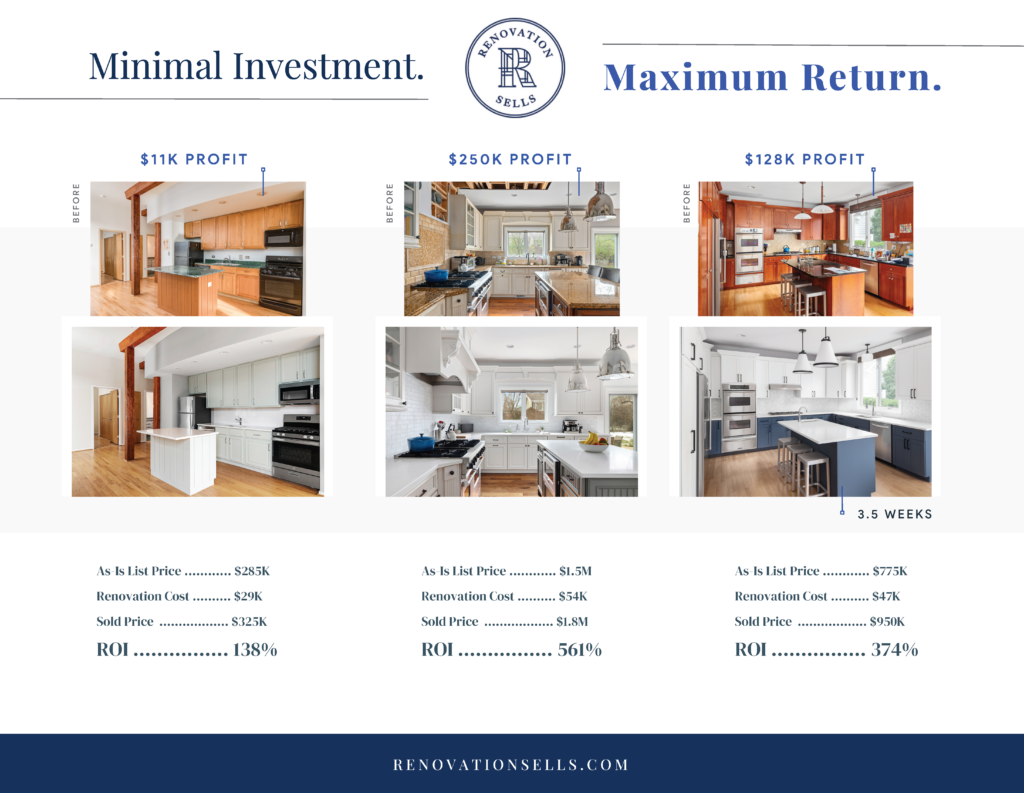
Renovation Sells is a company that offers affordable and timely renovations for people selling their homes. They specialize in designing and constructing affordable cosmetic renovations specifically tailored to the wants and needs of future buyers. Their services result in faster sales at higher prices, making homes ready for the market.
Renovation Sells works with experts to determine what home updates are needed based on the return on investment. They handle the design and renovation work, and help sellers get the most value out of their homes. Renovation Sells focuses on designing affordable cosmetic renovations that are specifically tailored to the wants of the future buyer.
Partnering with The Mortgage Architects: Renovation Loans for the Buy Side
Partnering with The Mortgage Architects, Renovation Sells helps on the buying side for home buyers experiencing high competition from other buyers resulting in bidding wars or getting priced out of the market. Depending on the property and financing goals, buyers facing bidding wars can also explore the Cash Offer Loan Program to make a financed offer more competitive. With a renovation loan from The Mortgage Architects, the home buyer can look at homes with less competition, complete the renovation before move-in, all with costs covered by the renovation loan mortgage, and the timely work completed by Renovation Sells. Buyers who need to purchase before selling may also be able to compete without a home-sale contingency, giving sellers greater certainty.
Case Studies: How Renovation Sells Adds Value to Properties
Renovation Sells has helped many homeowners and realtors increase the value of their properties while keeping costs low. View case studies on their website here.
The Demand for Move-In-Ready Homes
Data and research indicate that millennials and modern home buyers want move-in-ready homes. According to a survey from Bank of America, 67% of millennials are “likely” to buy a house in the next two years. As more and more millennials become homebuyers, they seek out homes that are move-in ready. Move-in ready homes sell faster, helping real estate agents sell more homes and helping homeowners sell at higher prices.
Make Your Home Instagram Ready 📸
If you’re a home seller or buyer looking to get the most value out of your property or find a move-in-ready home, connect with experts at Renovation Sells and The Mortgage Architects. Renovation Sells provides affordable and tailored renovations to make homes ready for the market, while The Mortgage Architects offers renovation loans to help buyers complete timely renovations before move-in. Don’t miss out on the opportunity to increase your home’s value or get your dream home – contact Renovation Sells and The Mortgage Architects today.
We use cookies and similar technologies to improve your experience on our website.
Read our Privacy Policy.