In this video, Nathan Jennison explains loan options that may help homeowners bridge the timing gap between buying a new home and selling the current one. The discussion highlights why the topic matters and what borrowers should consider before choosing a financing strategy.
Key takeaway: Mortgage guidelines and financial tradeoffs can vary by borrower, property, lender, and market conditions. Comparing options with an experienced independent mortgage broker can reveal a stronger path forward.
Want help applying this to your situation? Contact The Mortgage Architects for a personalized mortgage review.
This video is for educational purposes and is not a commitment to lend. Program guidelines, rates, and eligibility may change.
In this video, Nathan Jennison explains ways financed buyers can strengthen an offer and compete more effectively against cash buyers. The discussion highlights why the topic matters and what borrowers should consider before choosing a financing strategy.
Key takeaway: Mortgage guidelines and financial tradeoffs can vary by borrower, property, lender, and market conditions. Comparing options with an experienced independent mortgage broker can reveal a stronger path forward.
Want help applying this to your situation? Contact The Mortgage Architects for a personalized mortgage review.
This video is for educational purposes and is not a commitment to lend. Program guidelines, rates, and eligibility may change.
In this video, Nathan Jennison explains home title theft, common warning signs, and practical steps property owners can take to protect themselves. The discussion highlights why the topic matters and what borrowers should consider before choosing a financing strategy.
Key takeaway: Mortgage guidelines and financial tradeoffs can vary by borrower, property, lender, and market conditions. Comparing options with an experienced independent mortgage broker can reveal a stronger path forward.
Want help applying this to your situation? Contact The Mortgage Architects for a personalized mortgage review.
This video is for educational purposes and is not a commitment to lend. Program guidelines, rates, and eligibility may change.
Refinancing your mortgage can save money or change loan terms in ways that genuinely improve your financial life. But figuring out when to pull the trigger isn’t always obvious, especially with interest rates bouncing around the way they have in 2024 through 2026. This guide walks you through how I evaluate a refinance decision, what to watch for, and how to decide whether the numbers work in your favor today.
Key Takeaways
Don’t try to time the perfect mortgage rate. Focus on real monthly savings, total costs involved, and your financial goals instead.
I generally look for a refinance break even point of about 12 months or less, based on current interest rates and closing costs.
Refinancing now does not lock you out of refinancing again later if rates improve further.
Good reasons to refinance include lowering your rate, reducing your mortgage payment, shortening your loan term, removing mortgage insurance, or using a cash out refinance to access home equity wisely.
The single most useful tool for making this decision is a simple break-even calculation, not a rule of thumb about rate drops.
When Does Refinancing Make Sense Right Now?
If you’re wondering when to refinance mortgage, the short answer is: when the math works in your favor today. Not tomorrow, not when some analyst predicts rates will fall another half point. Today’s numbers are the only numbers you can actually act on.
Here are common situations where refinancing your mortgage often makes sense:
Your current rate is high enough that a new loan would create meaningful monthly savings (roughly $100–$200 or more per month on an average-sized loan).
You can switch from an adjustable rate mortgage to a stable fixed rate mortgage before your next rate adjustment.
You’ve built enough home equity to remove mortgage insurance and keep a similar rate.
You want to shorten your loan term to pay less total interest over the life of the loan.
When evaluating whether it’s time, look at total payment and loan term together, not just the new interest rate compared with your current mortgage. A slightly lower rate on a brand-new 30-year term could mean paying interest for years longer than necessary.
The decision should be driven by math-monthly savings versus costs, break even point-and your time horizon in the home. When is it worth it to refinance? It’s not about hitting a magic rate number. It’s about whether the savings justify the upfront costs before you’d move or sell.
Why Trying To “Time” Mortgage Rates Doesn’t Work
Many homeowners wait for the “perfect” rate and end up missing a refinance that already made financial sense. I see this regularly. Someone has a clear opportunity in front of them, but they hold off because they heard rates might drop another quarter point next month. Then rates jump back up, and the window closes.
Mortgage rates move quickly because they respond to inflation reports, Federal Reserve expectations, bond market reactions, and global economic events-factors no borrower can predict reliably. In early 2026, the 30-year fixed rate dipped close to 5.98% in February, then climbed back above 6.4% by mid-year. That swing happened in a matter of weeks.
My advice: evaluate a refinance based on today’s numbers-your savings, the costs involved, and your break even-rather than trying to guess where mortgage rates will be next month or next year. Refinancing is beneficial when rates drop by 0.75% to 1%, but even smaller drops can work depending on your loan amount and fees.
And here’s the part that surprises many people: refinancing now still leaves the door open to refinance again in the future if rates fall further.
Understanding Your Current Mortgage
Before making any refinance decision, pull out your current mortgage statement. You need a clear picture of what you have today.
Fixed rate mortgage: Note your rate, remaining term, current payment, and whether there is any prepayment penalty on the existing mortgage.
Adjustable rate mortgage: Identify the index, margin, next adjustment date, current interest rate, lifetime caps, and how high the payment could go. Adjustable rate mortgages can lead to fluctuating monthly payments that make budgeting difficult.
Mortgage insurance: Check whether you pay private mortgage insurance pmi or FHA mortgage insurance, and note the monthly cost.
Balance and equity: Capture your remaining loan balance, original loan amount, and approximate home value. This lets you estimate loan-to-value and your home equity percentage. Home equity is the difference between your home’s value and mortgage balance.
Having these details in front of you makes every comparison faster and more accurate.
How The Refinance Break-Even Point Works
The break even point is the number of months it takes for your monthly savings to repay your closing costs. It’s the single most important number in any refinance decision.
The formula is simple: calculate break-even by dividing closing costs by monthly savings.
Closing costs ÷ Monthly payment savings = Months to break even
A common break-even period is 24 months for refinancing, though I prefer to see it shorter. Break-even analysis helps assess if refinancing costs outweigh savings, especially if you might move within a few years.
A shorter break even gives you more flexibility if life changes-a job move, needing a bigger home, or any number of surprises. My general guideline: I usually like to see a break even of about 12 months or less. I’ll occasionally accept 18–24 months if there’s a strong strategic reason, like removing mortgage insurance or making a significant loan term change.
Refinancing makes sense if you stay beyond the break-even point. If you leave before it, you’ve essentially paid closing costs for nothing.
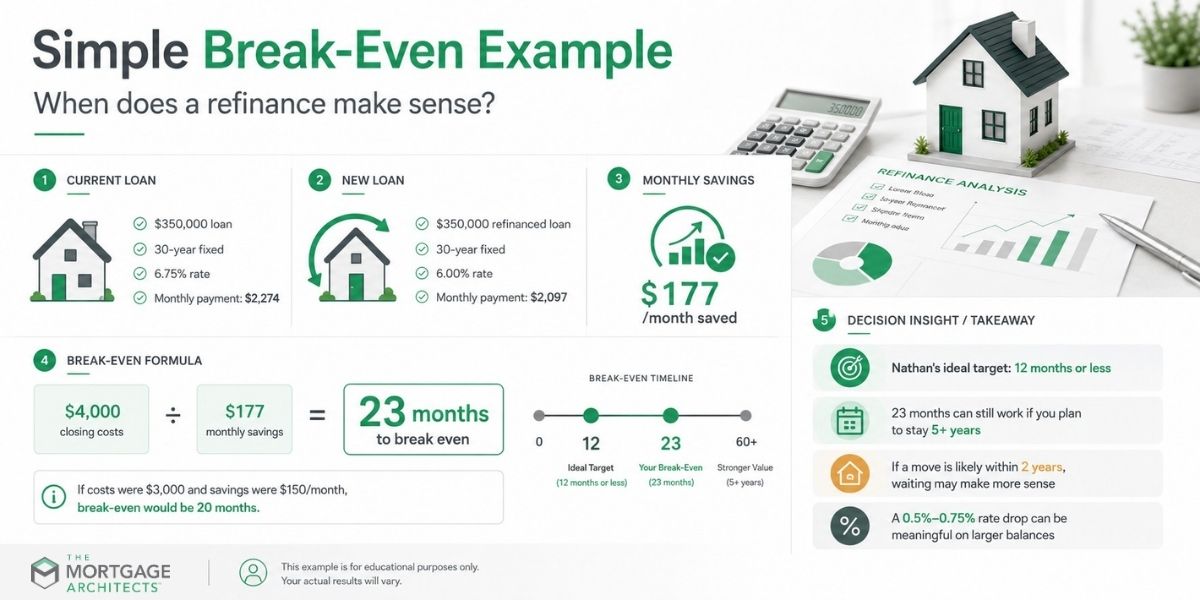
Simple Break-Even Example
Let’s use a realistic scenario. Say you have a $350,000 current loan at 6.75% on a 30-year fixed rate loan. You find a new loan at 6.00% fixed rate.
Old monthly mortgage payment (principal and interest): approximately $2,274
New monthly payment: approximately $2,097
Monthly savings: roughly $177
Now assume refinancing costs come in around $4,000. Using the formula:
$4,000 ÷ $177 = approximately 23 months to break even.
That’s close to my 12-month target but not quite there. However, if your lender fees are lower-say $3,000-the math changes. A break-even point example: $3,000 costs and $150 savings equals 20 months. Still workable if you plan to stay in the home well past that point.
A 1% rate drop can lead to significant long-term savings, and refinancing makes sense if you can lower your rate by 0.5% to 0.75%, especially on larger balances. If this homeowner plans to stay for five-plus years, even a 23-month break even works. But if a move is likely within two years, I’d say wait.
Good Reasons To Refinance Your Mortgage
Refinancing is a tool, not an automatic win. It should match specific financial goals. Before you start shopping offers, pick one or two main goals:
Lowering your interest rate or monthly payments
Shortening your loan term
Switching from an adjustable rate mortgage to a fixed rate
Removing mortgage insurance
Using a cash out refinance to access equity for a clear purpose
Let’s walk through each.
Lowering Your Interest Rate Or Monthly Payment
This is the classic “when refinance” scenario and one of the easiest to evaluate with numbers. Meaningful savings usually looks like saving at least $100–$200 per month for an average-sized loan, rather than chasing a specific percentage point drop.
If your credit score improved since you took out your original mortgage, or your debt-to-income ratio is better, you may qualify for a lower interest rate than what’s on your current mortgage. Rising home equity helps, too.
One important reminder: refinancing can restart your mortgage amortization process. If you go from 22 years remaining back to a fresh 30-year term, your new monthly payment might be lower, but you could end up paying interest over a much longer period. Compare scenarios: same remaining term versus a new 30-year fixed rate mortgage. Look at both monthly savings and lifetime total interest.
Shortening Your Loan Term While Keeping Payments Manageable
Refinancing from a 30-year into a 20- or 15-year fixed rate mortgage can help you become debt-free sooner and build equity faster in your home. Shortening a loan term can save tens of thousands in interest over the life of the loan.
A 15-year mortgage typically has lower interest rates than a 30-year mortgage, which compounds the benefit. But switching from a 30-year to a 15-year mortgage increases monthly payments significantly.
Shorter loan terms generally mean higher monthly payments but less total interest. This strategy works well when income has grown since you took out the existing loan, or after high interest debt like car loans or credit cards has been paid off.
Stress-test your budget before committing. Your payment should still be comfortable even if property taxes, insurance, or childcare costs rise. And remember: even without refinancing, making extra principal payments on your current mortgage is an alternative path to a shorter effective term and helps you pay off your mortgage sooner.
Switching Between Adjustable Rate And Fixed Rate
Changing your rate structure can be just as important as changing your rate level. Refinancing from an ARM to a fixed-rate mortgage stabilizes payments and removes the uncertainty of future adjustments.
Refinancing is especially beneficial as you approach the end of an ARM’s fixed period. If your adjustable rate mortgage is about to reset and rates are trending higher, locking into a fixed interest rate gives you a predictable monthly payment for the entire mortgage. Fixed-rate mortgages provide long-term stability against rising rates, and switching to a fixed-rate mortgage offers payment predictability that many homeowners value highly.
For moving from a fixed rate to an ARM, this may suit homeowners who expect to move or sell within a specific timeframe and are comfortable with the risk. Just review caps, margins, and the adjustment schedule carefully before deciding. The key factors here are how long you plan to stay and how much payment uncertainty you can absorb.
Removing Mortgage Insurance (PMI or FHA MIP)
Rising home values and paid-down principal can give you 20% or more home equity, creating a chance to remove mortgage insurance. Refinancing can eliminate PMI if home equity reaches 20%, and home value appreciation can help remove PMI sooner than you’d expect.
FHA loans can remove mortgage insurance by refinancing to conventional loans. If you have an FHA loan with lifetime MIP, a refinance to a conventional fixed rate loan can eliminate that monthly cost even if the rate stays similar. A new appraisal during refinancing may show increased home equity you didn’t realize you had.
Refinancing can help eliminate private mortgage insurance (PMI) on conventional loans, too. Sometimes refinancing removes it sooner than waiting for automatic cancellation on the existing mortgage.
The important step: compare the monthly mortgage insurance savings against any higher interest rate and the closing costs of the new loan. In some cases, you might be able to cancel PMI with your existing lender without a full refinance-I’d help you compare both paths.
Accessing Home Equity With A Cash Out Refinance
A cash out refinance lets you borrow against your home’s equity by replacing your existing mortgage with a larger one and taking the difference as a cash payment at closing. You can use cash from a refinance for home improvements or education, or to consolidate debt at a lower rate.
Common uses that can be financially sensible:
Consolidating high interest debt like credit cards or unsecured debt into a single, lower-rate loan payment
Funding major home improvements that increase the property’s value
Covering education expenses
But be clear-eyed about the tradeoffs. Cash-out refinancing converts unsecured debt into mortgage debt, which means your home is the collateral. Tapping home equity increases your loan balance and means paying interest over many years. A cash out refinance lets homeowners unlock home equity, but it should be done with a clear dollar amount and purpose in mind.
Before choosing this route, compare it with alternatives like a home equity loan or a home equity line of credit, especially if your current rate is much lower than today’s market. Avoid using equity for short-term or discretionary spending.
When Refinancing May Not Be Worth It
Sometimes the smartest move is staying with your current mortgage. Here’s when I’d usually advise holding off:
The break even point is too far out-more than 3–4 years-compared with how long you realistically plan to keep the home.
The monthly savings are minimal. If refinancing only saves you $30–$50 per month on a modest loan amount, the math rarely works after accounting for upfront costs.
You’re late in your mortgage term. If you’re close to paying off the existing loan, restarting a 30-year term can increase lifetime interest costs despite lower payments.
Your credit score or income has declined since you closed on your home. New loan terms might be worse than what you already have-higher annual percentage rate, more lender fees, or even required mortgage insurance.
You only need a small amount of cash. If your current rate is great and you just need $15,000, a home equity loan or home equity line might make more sense than replacing your entire mortgage.
Key Costs Involved In Refinancing
Even when mortgage rates drop to an attractive level, closing costs can make or break the decision. Refinancing costs range from 2% to 6% of the loan amount. On a $300,000 refinanced loan, that’s roughly $6,000 to $18,000.
Typical refinancing costs include:
Lender fees (origination, underwriting)
Appraisal fee
Title search and title insurance
Recording fees
Prepaid property taxes and insurance
Optional mortgage points to buy down the rate
Some lenders offer “no-cost” refinancing, where costs are covered by a slightly higher interest rate or rolled into the loan balance. This can work, but understand that you’ll pay more over time through higher interest costs.
These costs must be included in any break even calculation, whether paid out of pocket or financed. Always ask for a written loan estimate and compare the total cost over the first 3–5 years, not just the note rate.
How Your Credit Score And Home Equity Affect Timing
Both your credit score and home equity strongly influence what kind of refinance you can qualify for and at what interest rate.
Credit score: Most conventional loans require 620 or higher, but the best pricing goes to borrowers with scores above 740. Improving your credit score can qualify you for better rates. Pulling your credit report and paying down revolving debt before applying can help. Even checking your credit history for errors is worth the effort.
Home equity: Higher equity (lower loan-to-value) generally means better pricing and possibly no mortgage insurance on the new fixed rate loan. If you’ve been making monthly payments consistently and your area has seen price appreciation, you may have more equity than you think.
Waiting a few months to improve credit or pay down balances might shift a borderline refinance into clearly worthwhile territory. But balance this against rate risk: if mortgage rates are rising quickly, waiting for a small credit score improvement might actually cost more in a higher rate than it saves. These are key factors to weigh carefully.
Why Refinancing Now Doesn’t Trap You Later
A common fear: “If I refinance now and rates drop more, I’ll regret it.” I understand the concern, but here’s the reality.
As long as you meet program guidelines, you can refinance again later. There’s generally no rule that you can only refinance a mortgage once. Some lenders or programs may have minimum seasoning periods-for example, six months for certain cash out refinances, or specific requirements for a VA loan streamline-but these are usually short.
My philosophy: if the numbers work now with a strong break even and clear benefit, you don’t need to wait for a perfect, hypothetical future rate. Think in stages. It can be reasonable to do a first refinance to improve things, then revisit if there’s a substantial rate drop or life change later. The refinance process isn’t a one-time event.
How To Evaluate A Refinance Offer Step By Step
Here’s a quick checklist you can follow with any quote you receive:
Gather details on your current mortgage: Rate, term, balance, payment, mortgage insurance, remaining years, and any early payments or prepayment penalties.
Review the proposed new loan: Interest rate, fixed rate vs. adjustable rate mortgage, new term, estimated new monthly payment, and whether it’s rate-and-term or cash out refinancing. Understand what refinancing involves before signing anything.
Look at all costs on the loan estimate: Lender fees, third-party fees, and any mortgage points you’re paying to get a lower rate. Don’t overlook smaller line items-they add up.
Calculate the break even: Monthly savings divided into total closing costs equals months to break even. Compare that to how long you plan to stay in the home.
Decide whether the refinance aligns with your goals: Lower payments, faster payoff, remove PMI, access home equity, or debt consolidation. Does it fit your financial goals and your comfort level with payment changes?
If the refinance clears these steps and the mortgage makes sense for your situation, you’re in good shape to move forward. If not, there’s no shame in holding your existing loan and revisiting later.
Frequently Asked Questions About When To Refinance
These FAQs cover common concerns that don’t always get a full answer in the sections above. If you’re still on the fence, one of these might address what’s on your mind.
Is There A “Magic” Rate Drop That Means I Should Refinance?
There isn’t a universal magic number. You’ll often hear that refinancing is beneficial when rates drop by 0.75% to 1%, but the right answer depends on your loan amount, closing costs, and how long you’ll stay. A small rate drop on a large balance can save more than a big rate drop on a small balance. Use your actual numbers-loan balance, quoted rate, lender fees-with a break even calculation instead of relying on rules of thumb. That’s more useful than any percentage point guideline.
How Soon After Getting A Mortgage Can I Refinance?
Many conventional lenders allow rate-and-term refinancing after about six months of making monthly payments, though some may consider it sooner. Cash out refinance options often have longer seasoning requirements-six to twelve months of on-time loan payments is typical. Check your current loan documents for specific restrictions and confirm timing before starting the process. Bank accounts should be in good order, and your credit report should be recent.
Does It Make Sense To Refinance If I Might Move In A Few Years?
This is where the break even point matters most. If you’re likely to move before break even, refinancing usually doesn’t make sense to refinance. But consider a 14-month break even versus a planned move in 36 months-that still gives you nearly two years of net savings. If a move is uncertain or more than three years away, a refinance can still be reasonable if the math works.
Will Refinancing Hurt My Credit Score Long Term?
Refinancing typically causes a small, temporary dip due to a hard inquiry on your credit report and opening a new account. Over time, making on-time payments on the refinanced loan strengthens your credit history again. Multiple mortgage inquiries within a short shopping window-often 30 to 45 days-generally count as one inquiry for scoring purposes, so don’t be afraid to compare offers.
How Can I Tell If I Should Refinance Now Or Wait?
Use a quick checklist: there’s a clear financial benefit today, the break even lands at roughly 12 months or less, and you’re confident you’ll stay in the home past that point. Avoid waiting solely because “rates might go lower”-that’s market timing, and it’s impossible to predict accurately. If you’d like to run your specific numbers, I’m happy to walk through them with you. No pressure, just clarity on whether refinancing makes sense for your situation right now.
Every mortgage situation is different, and the right answer depends on your numbers-not a headline or a rate forecast. If you’re curious whether a mortgage refinance could work in your favor, reach out and let’s look at the details together. I’ll help you run the break even, compare the costs, and figure out whether now is the right time or whether holding your current loan is the smarter play. Either way, you’ll walk away with a clear answer.
Buying a home is a huge milestone—and if credit score questions are swirling in your head, you’re not alone. For many buyers, wondering what credit score is needed to buy a home in today’s market is one of the biggest stress points in the entire mortgage process.
Here’s the truth: your credit score matters, but it’s not the only thing that matters. And it definitely doesn’t have to stop you from buying a house.
Generally speaking, a higher credit score can improve your mortgage approval odds, unlock better interest rates, and lead to more favorable loan terms. On the flip side, a lower credit score might limit some options or increase costs—but it doesn’t automatically mean “no.”
The good news? There is no single minimum credit score needed to buy a home. Mortgage lenders look at your credit score as part of a much bigger picture that includes income, credit history, debt, and overall financial health. In today’s market, there are more loan programs than many buyers realize—even for those with less-than-perfect credit.
Why Credit Scores Matter More Than Ever
Mortgage lenders use a fico score, the most widely used among credit scoring models, and 90% of top lenders rely on it to assess borrower risk. Your credit score reflects things like payment history, credit utilization ratio, and how responsibly you manage credit accounts.
In today’s lending environment, credit scores affect:
Mortgage approval decisions
Mortgage rate and interest rates
Loan terms
Monthly payment amounts
Mortgage insurance and mortgage insurance premiums
There is a minimum credit score requirement for most loan programs, but hitting the minimum score is just the starting point. Lenders use credit scores to help determine approval and the offered interest rate. A higher credit score can mean lower monthly payments and help you save money over the life of the home loan.
Even small differences in credit score can change what you qualify for—and how much you pay.
Most buyers need a minimum credit score between 580 and 620, depending on the loan type and the lender. There is no single minimum credit score required by all mortgage lenders, because each lender sets its own criteria based on risk tolerance, loan type, income, debt, and other factors.
This is where a mortgage broker adds real value. Instead of being boxed into one lender’s rules, buyers can compare options across dozens of mortgage lenders, where the credit score is a key factor but different lenders may use different score cutoffs and loan programs.
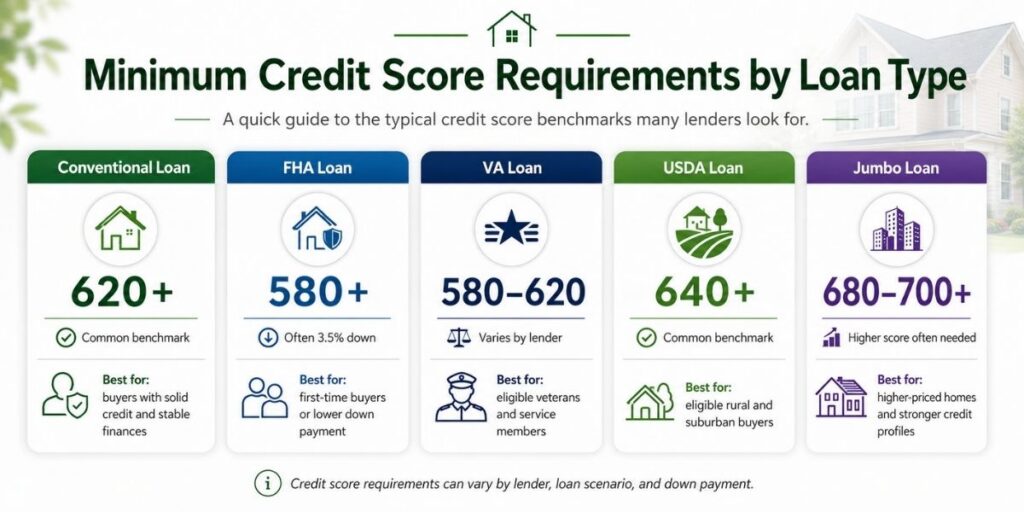
Minimum Credit Score Requirements by Loan Type
Conventional Loan
Typical minimum credit score: 620
Based on Fannie Mae guidelines
Conventional underwriting commonly relies on a three digit number, with most credit scores falling in the 300–850 range
Higher credit scores often lead to lower private mortgage insurance costs and better mortgage rates
Conventional mortgages usually have stricter credit score requirements but can be a strong long-term option for buyers with good credit and stable income, and conventional lenders often rely on the widely used FICO model when assessing risk; FICO® Scores are used by 90% of top lenders, including mortgage lenders, to assess borrower risk, with a typical score range from 300 to 850.
FHA Loan
Minimum credit score of 580 with a smaller down payment
Scores as low as 500 may qualify with a larger down payment
Backed by the Federal Housing Administration
FHA loans are government backed mortgages designed to help buyers with lower credit scores. They’re especially popular with first-time buyers or those rebuilding credit. FHA loans do require mortgage insurance premiums, particularly for borrowers with a lower credit score.
VA Loans
No official minimum credit score set by Veterans Affairs
Many lenders look for scores around 620
No private mortgage insurance required
VA loans are one of the most flexible options available for eligible borrowers and often offer excellent loan terms.
USDA Loans
Often require scores around 640, though some lenders allow lower
Designed for eligible rural and suburban areas
Income limits apply
Not all mortgage lenders offer USDA loans, so access to lenders who do offer USDA loans matters.
Jumbo Loans
Typically require credit scores 680–720 or higher
Used for higher-priced homes
Stricter standards due to increased lender risk
What Is Considered a Good Credit Score to Buy a House?
A good credit score is generally considered 680 or higher, and a credit score is a numerical measure of credit worthiness based on your credit history, typically ranging from 300 to 850, with higher numbers reflecting stronger credit health; while mortgage lenders often focus on FICO-type ranges, consumers may also see different credit scores built from multiple scoring models. This range often unlocks:
Lower interest rates
Better loan terms
Reduced mortgage insurance costs
That said, buyers with a lower credit score can still buy a house—it just takes the right strategy.
Lowest Credit Score to Get a Mortgage
Some programs allow approvals with lower credit scores, but there are trade-offs:
500–579: Very limited options and typically a larger down payment
580–619: FHA loans are more common
620+: Broader access to conventional loans
Lower credit scores often lead to higher monthly mortgage payments and higher overall costs.
Credit Score Requirements for First-Time Homebuyers
There’s no special credit score exemption for first-time buyers, but many programs are designed with flexibility:
If you’re new to the mortgage process, don’t assume you’re disqualified—many buyers are closer than they think.
What Credit Score Is Needed to Buy a $250,000–$400,000 Home?
Home price alone doesn’t set the credit score requirement. Mortgage lenders also look at:
Gross monthly income
Debt to income ratio
How much debt you carry
Down payment size
Estimated monthly payment
As loan amounts rise, lenders usually expect stronger overall financial profiles—but balance matters more than perfection.
Which Credit Score Do Mortgage Lenders Use?
Mortgage lenders pull credit reports from the three major credit bureaus—Experian, Equifax, and TransUnion. The middle score is typically used for mortgage approval.
Checking your credit report early is key. To stay informed, check your credit and monitor your own credit regularly, since a credit score update can happen as often as every month as credit report information changes. You can also get a free credit report and other free credit access through AnnualCreditReport.com to review each account and track changes.
Credit Factors That Affect Mortgage Approval
Credit scores are calculated based on different factors used in scoring models to evaluate a borrower’s credit profile.
Payment History On-time payments are the most important part of your credit score, accounting for 35% of your FICO® Score. Late payments, missed payments, and collection accounts are major negative signals that can significantly hurt approval odds.
Credit Utilization This compares credit card balances to your credit limit. Amounts owed, including credit utilization and total debt, make up 30% of your FICO® Score, so keeping balances below 30% of your total credit limit helps improve credit scores.
Credit History Length Longer-established credit accounts are generally viewed more favorably, and this factor makes up 15% of your FICO® Score, including the age of your oldest and newest accounts and even relevant closed accounts that still appear on your report. Opening new accounts and related inquiries count for 10% and can hurt approval odds if they happen too close to applying.
Credit Mix A healthy mix of credit accounts makes up 10% of your FICO® Score. Managing different types of credit, such as credit cards and auto loans, can support stronger scores.
How a Lower Credit Score Impacts Loan Terms
A lower credit score signals more risk to lenders when lending money and may lead to:
Higher interest rates
Less favorable loan terms
Higher monthly payments
Increased mortgage insurance
Over time, those differences add up, affecting whether you can borrow money at all and what rate lenders offer.
Down Payment vs Credit Score: Which Matters More?
It’s a balancing act:
A larger down payment can offset a lower credit score
FHA loans allow lower scores with higher down payments
Conventional loans weigh credit more heavily
Mortgage approval isn’t about one number—it’s about the full picture.
Can You Buy a House With Bad or Poor Credit?
Yes—absolutely. Buyers with poor credit may have fewer options and higher costs, but homeownership is still possible. Poor credit can also affect renting, insurance pricing, and utility deposits, since landlords, insurers, and utility providers may review credit to gauge whether applicants meet financial obligations. Working with multiple lenders can improve approval odds and uncover programs designed for buyers rebuilding credit.
How to Improve Your Credit Score Before Buying
Simple steps that help:
Pay down credit card balances
Avoid new credit inquiries and new credit accounts
Review your credit report for errors
Make consistent on-time payments
Even modest improvements can expand loan options.
Common Mortgage Application Mistakes to Avoid
Opening new credit before closing
Missing bank statements or documentation
Ignoring credit report errors
Preparation makes the mortgage process smoother—and far less stressful.
Final Takeaway
Most buyers can qualify with credit scores between 580 and 620, but higher credit scores often mean better rates, lower costs, and more flexibility. Your credit score matters—but it’s only one piece of the puzzle.
At The Mortgage Architects, we help buyers compare loan options across dozens of lenders, explain how credit scores affect real-world outcomes, and create a clear path forward—whether you’re buying your first home, refinancing, or rebuilding credit.
You don’t have to be “perfect” to buy a home. You just need the right plan—and the right guide to help you build it 🏡✨
Frequently Asked Questions
What role does credit mix play in my credit score for mortgage approval?
Credit mix, which accounts for about 10% of your FICO® Score, reflects the variety of credit accounts you manage, such as credit cards, auto loans, and mortgages. A healthy credit mix can positively impact your credit score by showing lenders you can responsibly handle different types of credit, which may improve your mortgage approval chances.
How do hard inquiries affect my credit score when applying for a mortgage?
Hard inquiries occur when lenders check your credit report as part of a loan application. Each hard inquiry can lower your credit score slightly and may stay on your report for up to two years. Multiple inquiries in a short period can have a bigger impact, so it’s best to limit new credit applications before applying for a mortgage.
Why do different lenders use different credit score requirements?
Most lenders use credit score-based criteria, but each lender sets its own minimum score requirements based on their risk tolerance, loan products, and underwriting guidelines. This means that a good credit score for one lender might differ from another, which is why shopping around and comparing lenders can help you find the best mortgage options.
What are good credit habits to improve my credit score before buying a home?
Good credit habits include paying bills on time, keeping credit card balances low relative to your credit limits, avoiding opening new credit accounts unnecessarily, regularly reviewing your credit reports for errors, and maintaining a diverse credit mix. These habits contribute to better credit health and can help you qualify for better mortgage terms.
How does my credit score impact my financial well-being beyond mortgage approval?
Your credit score plays a critical role in your overall financial well-being. It affects not only mortgage approval and interest rates but also your ability to secure loans or credit cards, qualify for rental housing, and even the premiums you pay for insurance or deposits required by utility companies. Maintaining a good score can save you money and provide greater financial flexibility.
Getting preapproved for a mortgage can feel like a major milestone. For many buyers, it is the moment the dream starts to feel real. You have a number. You know what you can shop for. You may even feel ready to write an offer.
But here is the part not enough people talk about: a preapproval is only as strong as the lender behind it.
A preapproval should give you confidence, not create false security. When a lender rushes through the details, overlooks important income questions, or avoids hard conversations, it can put your entire home purchase at risk.
That is why choosing a lender you can trust is not just a nice bonus. It is one of the most important decisions you make in the homebuying process.
A Preapproval Is Not Just a Piece of Paper
A strong preapproval requires more than plugging numbers into a system. It requires a real review of your financial picture, including your income, employment history, credit, assets, debts, and the type of loan program that actually fits your situation.
This is especially important for buyers with less traditional income.
For example, self-employed buyers often have additional guidelines to meet. In many cases, lenders need to verify a longer history of self-employment income before that income can be used to qualify. If that detail is missed early, it can become a major problem once the buyer is already under contract.
And that is where trust matters.
A good lender will not just tell you what you want to hear. They will tell you what you need to know before you are deep into the process, with earnest money, inspections, timelines, sellers, and agents all counting on the loan to move forward. That includes explaining financing options that can strengthen your offer when you need to buy before selling your current home.
The Real Danger Is Avoiding the Tough Conversation
Mortgage problems happen. Files can get complicated. Guidelines can shift depending on the buyer’s income, property type, loan program, or documentation.
The issue is not always that a problem comes up.
The bigger issue is when a lender avoids the conversation.
When a lender realizes there is a problem but does not communicate clearly, buyers lose valuable time. Real estate agents are left guessing. Sellers get frustrated. The closing timeline gets tighter. And the buyer may feel blindsided by something that should have been discussed much earlier.
In a competitive housing market, time matters. Losing even one or two weeks because a lender is not being direct can put everyone in a tough position.
The Right Lender Looks for a Real Path Forward
An experienced mortgage advisor does more than identify the problem. They help determine whether there is another responsible way forward.
Sometimes that may mean restructuring the file. Sometimes it may mean looking at a different loan program. In some cases, depending on the buyer’s goals and property type, an option like a debt service coverage ratio loan may be worth discussing because it looks at the property’s income potential rather than the borrower’s personal income in the traditional way.
Not every loan program is right for every buyer. That is exactly why it is so important to work with someone who understands the guidelines, asks the right questions upfront, and explains your options clearly.
The goal is not to force a loan to work. The goal is to help you understand what is possible, what is realistic, and what path gives you the strongest chance of getting to the closing table.
What Homebuyers Should Look For in a Mortgage Lender
When choosing a mortgage lender, do not only ask about rates. Rates matter, of course, but so does the quality of the advice behind the numbers. It also helps to compare the differences between a mortgage broker and a bank, including lender access, costs, and service.
A trustworthy mortgage lender should be willing to:
Ask detailed questions before issuing a preapproval.
Review your income and documentation carefully.
Explain potential issues early.
Be honest when something does not work.
Communicate clearly with you and your real estate agent.
Own mistakes if they happen.
Help you compare realistic loan options.
Protect your long-term interests, not just the transaction.
The best lender is not the one who says yes the fastest. It is the one who gives you the clearest, most accurate picture of where you stand.
Honest Guidance Helps You Buy With Confidence
Buying a home is a big financial decision. You deserve a lender who is direct, responsive, and willing to have the hard conversations when needed.
That kind of honesty may not always feel exciting in the moment, but it protects you. It helps you avoid surprises. It gives your real estate agent better information. And it allows everyone involved to make decisions based on facts instead of assumptions.
A strong mortgage experience is built on trust, communication, and strategy.
When you have the right person on your team, you are not just getting a preapproval. You are getting guidance from someone who is working to help you make a smart move with confidence.
Whether you’re ready to buy or just need answers, The Mortgage Architects is here to help. Call Now (720) 610-0113 to talk strategy and take the first step with confidence.
We use cookies and similar technologies to improve your experience on our website.
Read our Privacy Policy.