
Tag: Loan Programs

What Credit Score Is Needed to Buy a Home in Today’s Market?

Buying a home is a huge milestone—and if credit score questions are swirling in your head, you’re not alone. For many buyers, wondering what credit score is needed to buy a home in today’s market is one of the biggest stress points in the entire mortgage process.

Here’s the truth: your credit score matters, but it’s not the only thing that matters. And it definitely doesn’t have to stop you from buying a house.

Generally speaking, a higher credit score can improve your mortgage approval odds, unlock better interest rates, and lead to more favorable loan terms. On the flip side, a lower credit score might limit some options or increase costs—but it doesn’t automatically mean “no.”

The good news? There is no single minimum credit score needed to buy a home. Mortgage lenders look at your credit score as part of a much bigger picture that includes income, credit history, debt, and overall financial health. In today’s market, there are more loan programs than many buyers realize—even for those with less-than-perfect credit.

Visual guide showing credit score ranges from poor to excellent and how higher credit scores may support better mortgage options and rates.

Why Credit Scores Matter More Than Ever

Mortgage lenders use a fico score, the most widely used among credit scoring models, and 90% of top lenders rely on it to assess borrower risk. Your credit score reflects things like payment history, credit utilization ratio, and how responsibly you manage credit accounts.

In today’s lending environment, credit scores affect:

  • Mortgage approval decisions
  • Mortgage rate and interest rates
  • Loan terms
  • Monthly payment amounts
  • Mortgage insurance and mortgage insurance premiums

There is a minimum credit score requirement for most loan programs, but hitting the minimum score is just the starting point. Lenders use credit scores to help determine approval and the offered interest rate. A higher credit score can mean lower monthly payments and help you save money over the life of the home loan.

Even small differences in credit score can change what you qualify for—and how much you pay.

Most buyers need a minimum credit score between 580 and 620, depending on the loan type and the lender. There is no single minimum credit score required by all mortgage lenders, because each lender sets its own criteria based on risk tolerance, loan type, income, debt, and other factors.

This is where a mortgage broker adds real value. Instead of being boxed into one lender’s rules, buyers can compare options across dozens of mortgage lenders, where the credit score is a key factor but different lenders may use different score cutoffs and loan programs.
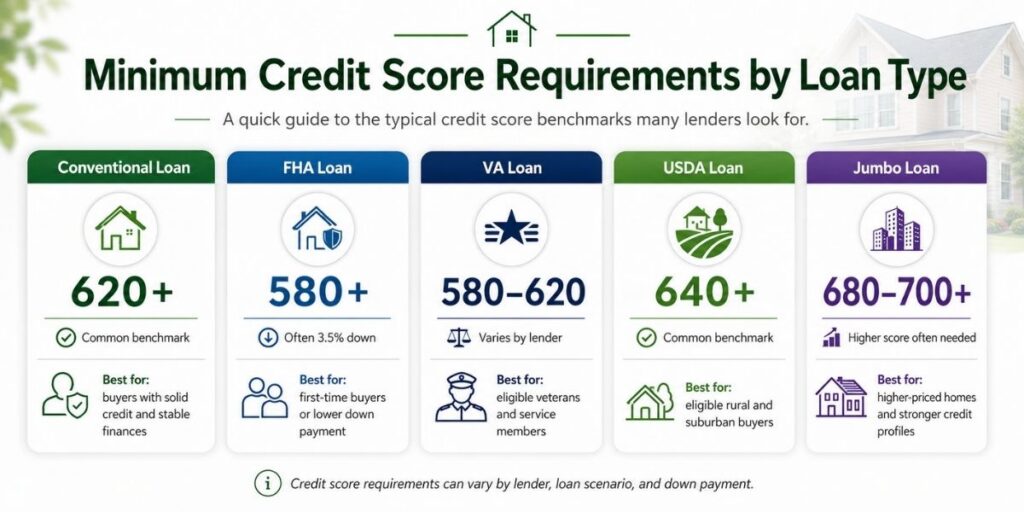
Comparison graphic showing typical minimum credit score benchmarks for conventional, FHA, VA, USDA, and jumbo mortgage loan types.

Minimum Credit Score Requirements by Loan Type

Conventional Loan

  • Typical minimum credit score: 620
  • Based on Fannie Mae guidelines
  • Conventional underwriting commonly relies on a three digit number, with most credit scores falling in the 300–850 range
  • Higher credit scores often lead to lower private mortgage insurance costs and better mortgage rates

Conventional mortgages usually have stricter credit score requirements but can be a strong long-term option for buyers with good credit and stable income, and conventional lenders often rely on the widely used FICO model when assessing risk; FICO® Scores are used by 90% of top lenders, including mortgage lenders, to assess borrower risk, with a typical score range from 300 to 850.

FHA Loan

  • Minimum credit score of 580 with a smaller down payment
  • Scores as low as 500 may qualify with a larger down payment
  • Backed by the Federal Housing Administration

FHA loans are government backed mortgages designed to help buyers with lower credit scores. They’re especially popular with first-time buyers or those rebuilding credit. FHA loans do require mortgage insurance premiums, particularly for borrowers with a lower credit score.

VA Loans

  • No official minimum credit score set by Veterans Affairs
  • Many lenders look for scores around 620
  • No private mortgage insurance required

VA loans are one of the most flexible options available for eligible borrowers and often offer excellent loan terms.

USDA Loans

  • Often require scores around 640, though some lenders allow lower
  • Designed for eligible rural and suburban areas
  • Income limits apply

Not all mortgage lenders offer USDA loans, so access to lenders who do offer USDA loans matters.

Jumbo Loans

  • Typically require credit scores 680–720 or higher
  • Used for higher-priced homes
  • Stricter standards due to increased lender risk

What Is Considered a Good Credit Score to Buy a House?

A good credit score is generally considered 680 or higher, and a credit score is a numerical measure of credit worthiness based on your credit history, typically ranging from 300 to 850, with higher numbers reflecting stronger credit health; while mortgage lenders often focus on FICO-type ranges, consumers may also see different credit scores built from multiple scoring models. This range often unlocks:

  • Lower interest rates
  • Better loan terms
  • Reduced mortgage insurance costs

That said, buyers with a lower credit score can still buy a house—it just takes the right strategy.

Lowest Credit Score to Get a Mortgage

Some programs allow approvals with lower credit scores, but there are trade-offs:

  • 500–579: Very limited options and typically a larger down payment
  • 580–619: FHA loans are more common
  • 620+: Broader access to conventional loans

Lower credit scores often lead to higher monthly mortgage payments and higher overall costs.

Credit Score Requirements for First-Time Homebuyers

There’s no special credit score exemption for first-time buyers, but many programs are designed with flexibility:

If you’re new to the mortgage process, don’t assume you’re disqualified—many buyers are closer than they think.

What Credit Score Is Needed to Buy a $250,000–$400,000 Home?

Home price alone doesn’t set the credit score requirement. Mortgage lenders also look at:

  • Gross monthly income
  • Debt to income ratio
  • How much debt you carry
  • Down payment size
  • Estimated monthly payment

As loan amounts rise, lenders usually expect stronger overall financial profiles—but balance matters more than perfection.

Which Credit Score Do Mortgage Lenders Use?

Mortgage lenders pull credit reports from the three major credit bureaus—Experian, Equifax, and TransUnion. The middle score is typically used for mortgage approval.

Checking your credit report early is key. To stay informed, check your credit and monitor your own credit regularly, since a credit score update can happen as often as every month as credit report information changes. You can also get a free credit report and other free credit access through AnnualCreditReport.com to review each account and track changes.

Credit Factors That Affect Mortgage Approval

Credit scores are calculated based on different factors used in scoring models to evaluate a borrower’s credit profile.

Payment History
On-time payments are the most important part of your credit score, accounting for 35% of your FICO® Score. Late payments, missed payments, and collection accounts are major negative signals that can significantly hurt approval odds.

Credit Utilization
This compares credit card balances to your credit limit. Amounts owed, including credit utilization and total debt, make up 30% of your FICO® Score, so keeping balances below 30% of your total credit limit helps improve credit scores.

Credit History Length
Longer-established credit accounts are generally viewed more favorably, and this factor makes up 15% of your FICO® Score, including the age of your oldest and newest accounts and even relevant closed accounts that still appear on your report. Opening new accounts and related inquiries count for 10% and can hurt approval odds if they happen too close to applying.

Credit Mix
A healthy mix of credit accounts makes up 10% of your FICO® Score. Managing different types of credit, such as credit cards and auto loans, can support stronger scores.

How a Lower Credit Score Impacts Loan Terms

A lower credit score signals more risk to lenders when lending money and may lead to:

  • Higher interest rates
  • Less favorable loan terms
  • Higher monthly payments
  • Increased mortgage insurance

Over time, those differences add up, affecting whether you can borrow money at all and what rate lenders offer.

Down Payment vs Credit Score: Which Matters More?

It’s a balancing act:

  • A larger down payment can offset a lower credit score
  • FHA loans allow lower scores with higher down payments
  • Conventional loans weigh credit more heavily

Mortgage approval isn’t about one number—it’s about the full picture.

Can You Buy a House With Bad or Poor Credit?

Yes—absolutely. Buyers with poor credit may have fewer options and higher costs, but homeownership is still possible. Poor credit can also affect renting, insurance pricing, and utility deposits, since landlords, insurers, and utility providers may review credit to gauge whether applicants meet financial obligations. Working with multiple lenders can improve approval odds and uncover programs designed for buyers rebuilding credit.

Checklist graphic showing steps to improve credit before buying a home, including paying bills on time, lowering balances, avoiding new debt, checking credit reports, disputing errors, and speaking with a mortgage professional.

How to Improve Your Credit Score Before Buying

Simple steps that help:

  • Pay down credit card balances
  • Avoid new credit inquiries and new credit accounts
  • Review your credit report for errors
  • Make consistent on-time payments

Even modest improvements can expand loan options.

Common Mortgage Application Mistakes to Avoid

  • Opening new credit before closing
  • Missing bank statements or documentation
  • Ignoring credit report errors

Preparation makes the mortgage process smoother—and far less stressful.

Final Takeaway

Most buyers can qualify with credit scores between 580 and 620, but higher credit scores often mean better rates, lower costs, and more flexibility. Your credit score matters—but it’s only one piece of the puzzle.

At The Mortgage Architects, we help buyers compare loan options across dozens of lenders, explain how credit scores affect real-world outcomes, and create a clear path forward—whether you’re buying your first home, refinancing, or rebuilding credit.

You don’t have to be “perfect” to buy a home. You just need the right plan—and the right guide to help you build it 🏡✨

Frequently Asked Questions

What role does credit mix play in my credit score for mortgage approval?

Credit mix, which accounts for about 10% of your FICO® Score, reflects the variety of credit accounts you manage, such as credit cards, auto loans, and mortgages. A healthy credit mix can positively impact your credit score by showing lenders you can responsibly handle different types of credit, which may improve your mortgage approval chances.

How do hard inquiries affect my credit score when applying for a mortgage?

Hard inquiries occur when lenders check your credit report as part of a loan application. Each hard inquiry can lower your credit score slightly and may stay on your report for up to two years. Multiple inquiries in a short period can have a bigger impact, so it’s best to limit new credit applications before applying for a mortgage.

Why do different lenders use different credit score requirements?

Most lenders use credit score-based criteria, but each lender sets its own minimum score requirements based on their risk tolerance, loan products, and underwriting guidelines. This means that a good credit score for one lender might differ from another, which is why shopping around and comparing lenders can help you find the best mortgage options.

What are good credit habits to improve my credit score before buying a home?

Good credit habits include paying bills on time, keeping credit card balances low relative to your credit limits, avoiding opening new credit accounts unnecessarily, regularly reviewing your credit reports for errors, and maintaining a diverse credit mix. These habits contribute to better credit health and can help you qualify for better mortgage terms.

How does my credit score impact my financial well-being beyond mortgage approval?

Your credit score plays a critical role in your overall financial well-being. It affects not only mortgage approval and interest rates but also your ability to secure loans or credit cards, qualify for rental housing, and even the premiums you pay for insurance or deposits required by utility companies. Maintaining a good score can save you money and provide greater financial flexibility.

Man celebrating with raised fist next to a briefcase full of cash, illustrating a cash-out refinance loan concept.

Cash Offer Loan Program: How to Compete Like a Cash Buyer Without Being Rich

What if you could make a cash offer without having hundreds of thousands of dollars sitting in your bank account? Enter the Cash Offer Loan Program.

This unique program gives everyday buyers the competitive edge of a cash offer, making it easier to win bidding wars, negotiate better deals, and close faster—even with as little as 5% down.

Let’s break down how it works, who it’s for, and why it could be the smartest move in today’s housing market.


Why Are Cash Offers So Powerful in Real Estate?

According to Nathan Jennison:

“Cash offers bring a much greater level of certainty to the table. Sellers know loans can fall apart—but cash is guaranteed to close.”

And the data backs that up. A University of California San Diego study found that cash buyers pay around 12% less on average than those using traditional financing. That’s a huge savings on a $500,000 home—up to $60,000!

Why do sellers prefer cash?

  • Speed: Cash deals can close in as little as 10 days.
  • Certainty: No waiting on lender approvals or appraisals.
  • Leverage: Sellers will often accept lower offers just to avoid the uncertainty of financing.

Who Is This Program For?

This isn’t just for the wealthy. In fact, it’s designed specifically for buyers who don’t have hundreds of thousands in liquid cash but still want to compete like they do.

Here are a few ideal candidates:

1. First-Time Homebuyers

Trying to buy your first home in a hot market can feel like you’re constantly losing out to investors or wealthier buyers.

“We can now level the playing field for first-time buyers. You don’t need perfect credit or a massive down payment,” says Jennison.

  • Minimum credit score: 640
  • Down payment as low as 5%
  • Close in as little as 10 days

2. Move-Up Buyers

Already own a home, but trying to secure your next one before selling? The Cash Offer Loan lets you buy first—without needing to rush the sale of your current home.

3. Buyers in Competitive Markets

In cities where homes get multiple offers within days, making a traditional offer often just isn’t enough.

“You’re spending around $10,000 on the program, but saving up to $30,000 or more by getting your offer accepted and negotiating a better deal,” Jennison explains.


How the Cash Offer Loan Works

Here’s a simplified look at the process:

Step 1: Get Pre-Approved

You’ll be pre-approved not just for your mortgage but also for the short-term cash loan that lets you make an all-cash offer.

Step 2: Make Your Cash Offer

Use the cash loan to make a strong, non-contingent offer—just like an investor.

Step 3: Win the House

Your cash offer gives you a much higher chance of acceptance, especially in competitive bidding situations.

Step 4: Close in 10 Days

Once the seller accepts, you can close in as little as 10 days.

Step 5: Refinance

After closing, Mortgage Architects quickly works to refinance you out of the short-term loan into a traditional mortgage.

“We’re working to refinance you as quickly as possible—sometimes in just 21 days,” says Jennison.


What Does It Cost?

Yes, this program has fees—but the potential savings far outweigh the costs. Here’s an example based on a $500,000 home:

Program Costs:

  • 5% down payment: $25,000
  • 10% interest (short-term loan): $2,730 for 21 days
  • Origination fee:
    • 1.5% if putting 5% down ($7,125)
    • 1% if putting 10% down ($4,750)

Total Direct Costs: ~$9,855 (max scenario)

Now compare that to the potential savings of 6–12% on the purchase price:

  • 6% savings on $500,000 = $30,000
  • Even after fees, you come out $20,000 ahead

“It’s a 3:1 return on your investment. That’s really strong,” says Jennison.


Why This Program Matters Right Now

With low inventory and high buyer demand, sellers are calling the shots. That means speed, certainty, and leverage are more important than ever.

The Cash Offer Loan Program lets regular buyers:

  • Compete with investors and wealthy cash buyers
  • Win bidding wars more often
  • Negotiate better purchase prices
  • Avoid costly contingencies

And best of all? You don’t need perfect credit or massive savings to do it.

“This is one more way Mortgage Architects helps you win—by giving you the tools, strategy, and support to make smarter, faster, and stronger offers,” says Jennison.


Is the Cash Offer Loan Right for You?

If you’ve been struggling to get your offer accepted, losing to cash buyers, or want to avoid overpaying in a bidding war—this program might be exactly what you need.

✅ Great for first-time buyers
✅ Ideal for competitive markets
✅ Smart for move-up buyers
✅ Works with 640+ credit
✅ Only 5% down required


Next Steps: Let’s Get You Pre-Approved

Ready to stand out in the market and finally win the home of your dreams?

Reach out to Nathan Jennison and the team at Mortgage Architects to get pre-approved for the Cash Offer Loan Program. You’ll gain a competitive edge and unlock the power of cash—without needing to be a millionaire.

👉 Contact us today and let’s get started. Your dream home might be one winning offer away.

Mortgage broker pointing toward a for-sale sign in a buy before you sell home financing graphic.

How an Equity Bridge Loan Helps You Buy Before You Sell

Without an equity bridge loan, buying a new home while still owning your current one can feel like trying to leap across a canyon without a bridge. You need access to your home equity for a down payment—but you can’t access it until you sell.

If that’s your situation, you’re not alone. Many families are stuck in this tricky transition. That’s where the Instant Equity Bridge Loan becomes a lifeline.

This smart solution helps you unlock your equity early, so you can make a non-contingent offer on your next home—and move forward with confidence.


A Real-Life Scenario: The Martins’ Home Buying Dilemma

Let’s imagine the Martins—a growing family of five. Their current home served them well when the kids were little, but now it’s tight. Sharing bedrooms and limited storage is taking a toll on everyone.

They find a perfect new home: more space, a better school district, and a backyard made for summer BBQs. But like many families, their equity is tied up in their current home, and they don’t have the funds available for a down paymentyet.

Every offer they submit must be contingent on selling their home first, and in a competitive market, that puts them at a serious disadvantage.

That’s when they discover the Equity Bridge Loan.


Why Contingent Offers Are Risky

In today’s fast-paced real estate environment, sellers aren’t keen on waiting.

Sellers are much more likely to take a non-contingent offer, even if it’s for a lower price,” says Nathan Jennison of The Mortgage Architects. “That’s why we created a program to help buyers unlock the equity in their existing home before they sell.”

The Martins used the Equity Bridge Loan to tap into their home equity before listing their house, making them non-contingent buyers with strong offers.


What is an Equity Bridge Loan?

An equity bridge loan lets you borrow against the equity in your current home before you sell it. This gives you the cash you need for the down payment and closing costs on a new home—without waiting for your old home to sell.

Key Features:

  • No monthly payments required
  • Access equity from a listed or unlisted property
  • Use alongside other programs like the Guaranteed Backup Contract
  • Strengthen your purchase offers and speed up your timeline

How the Process Works

Here’s how you can make your move seamless with an equity bridge loan:

  1. Get Pre-Approved
    First, you’ll get pre-approved for your new mortgage and the equity bridge loan with The Mortgage Architects.
  2. Shop Without Contingencies
    You’re now ready to make non-contingent offers that stand out in a seller’s market.
  3. Close on the Bridge Loan
    About 4 days before your new home purchase, the bridge loan is funded—giving you the cash needed to close.
  4. Move In First, Sell After
    You move into your new home, then list your previous home for sale without the pressure of a rushed timeline.
  5. Pay Off the Bridge Loan at Sale
    When your current home sells, the proceeds pay off the bridge loan—done and done.

How Much Does It Cost?

Let’s walk through a typical example for a $200,000 equity bridge loan:

Cost Breakdown:

  • Lender Fee:
    • 2% (if in first position) = $4,000
    • 2.5% (if in second position) = $5,000
  • Interest:
    • 10% annual rate
    • About $1,642 for 30 days
  • Origination Fee:
    • Waived if The Mortgage Architects handles your purchase mortgage
    • Otherwise, 1% ($2,000 on $200,000)

Estimated Total:

$5,642 – $8,642, depending on loan position and timing.

While this isn’t a free service, it’s often a small price to pay to avoid losing your dream home or carrying double housing costs from moving into temporary lodging.


Equity Bridge Loan Frequently Asked Questions

What types of homes qualify?

Your current home can be:

  • Listed
  • Unlisted
  • Under contract
    This program is flexible.

Are there monthly payments?

No monthly payments are required. Interest accrues and is paid off when your current home sells.

How long can I keep the loan?

This is meant to be a short-term loan—typically used for 30–90 days.

Can I use this with other offers?

Yes! Pair it with:

  • Guaranteed Backup Contract
  • Cash Offer Loan Program These combinations help you negotiate from the strongest possible position.

Why This Matters: The Martins’ Win

With their bridge loan in place, the Martins made a strong offer on the perfect home—and won. They moved in stress-free, then listed their previous home once they were comfortably settled.

Thanks to the Instant Equity Bridge Loan:

✅ They didn’t have to move twice
✅ They avoided contingent offers
✅ They accessed their equity when they needed it most


Final Thoughts from Nathan Jennison

“This is another way The Mortgage Architects help you move forward. We help you negotiate from a stronger position and transition homes in a way that’s convenient and cost-effective.”

If you’re caught in the in-between of buying and selling, the Equity Bridge Loan might be the smartest step you take.

Graphic explaining non-contingent home offers with a guaranteed backup contract and housing illustration.

Guaranteed Backup Contracts: How a Non-Contingent Offer Can Help You Buy Before You Sell

Making a non-contingent offer in today’s competitive housing market can be the difference between winning your dream home—or losing out to a more prepared buyer.

If you’re a homeowner who wants to buy a new home before selling your current one, but aren’t sure how to manage the financial overlap, there’s a strategic solution that allows you to move forward without making your offer contingent on a home sale.

It’s called a Non-Contingent Guaranteed Backup Contract, and it’s giving buyers more control, flexibility, and buying power.

A Hypothetical Scenario: How the Thompson Family Could Benefit

Imagine a family—let’s call them the Thompsons—who’ve outgrown their starter home. With two kids and a dog, they’re ready to upgrade to a larger home with a yard and better school district.

The catch? They can’t qualify for a new mortgage while still carrying their current one. Listing their home before buying feels risky, and they don’t want to miss out on a great new property.

This is where a non-contingent offer using the Guaranteed Backup Contract comes in. It allows the Thompsons to move forward with confidence, knowing they have a fallback plan if their home doesn’t sell in time.

“This program is designed to give families like the Thompsons the peace of mind and flexibility they need. You can move forward without being contingent on selling first, and that makes all the difference in today’s fast-moving market.” – Nathan Jennison, Mortgage Architects

What Is a Non-Contingent Guaranteed Backup Contract?

It may sound complex, but it’s surprisingly straightforward.

How It Works:

  • It’s a simple purchase contract placed on your current (departing) residence.
  • This guaranteed back up contract lets you make a non-contingent offer and remove the sale contingency, helping you secure the new home with more confidence.
  • It improves your debt-to-income ratio by letting you exclude your current mortgage payment when qualifying for the new loan.
  • You get up to 120 days post-purchase to sell your existing home.
  • A lender guarantees to buy your home if it doesn’t sell, protecting your transaction and helping prevent the risk of carrying two homes at once.

Why It Works: Backed by Fannie Mae Guidelines

This program isn’t just clever financing—it aligns with Fannie Mae and Freddie Mac guidelines. Here’s why that matters:

  • With a signed, executed contract on your current home under a bona fide, guaranteed backup contract, lenders can exclude that mortgage from your debt-to-income ratio.
  • This can make qualification and approval for a new mortgage easier by keeping your current mortgage payment from weighing down DTI.
  • The Guaranteed Backup Contract is structured to meet agency standards, which is an important underwriting consideration and can support faster pre approval.

Cost Breakdown: Affordable Peace of Mind

You might expect a program like this to come with a hefty price tag. But the cost is surprisingly reasonable, and one of the key benefits is being able to make stronger offers with less overlap risk.

  • Flat Fee: $2,500 – $3,500 administrative fee that you pay as the program option fee; option fees for GBCs typically include a flat administrative fee or a percentage of the home’s final sale price
  • Minimum Down Payment: 5% (for a conventional loan)
  • Other Fees: Standard loan closing costs still apply

For just $2,500 – $3,500, you unlock the ability to make a strong, non-contingent offer and reduce the financial stress of juggling two properties.

Who Should Consider a Non-Contingent Offer?

This strategy is ideal for homeowners in several common scenarios:

You Should Consider It If:

  • Your home is listed or under contract, but the buyer backs out last minute.
  • You’ve found your dream house but haven’t sold your current one.
  • You want to make a stronger, more competitive offer in a competitive market, with fewer contingencies and proof of funds to help sellers see a strong offer.
  • In a seller’s market, sellers often favor the highest offer with the fewest contingencies, which can help you win and close faster.
  • Your debt-to-income ratio is too high with both mortgages included.

What’s the Catch? Worst Case Scenario Explained

Every program has its fine print, and this one is no exception.

  • The lender’s offer will be around 78% of your home’s estimated market value, based on an automated valuation model.
  • If the home doesn’t sell within 120 days, you can request an extension—but the absolute deadline is 180 days, and if it still doesn’t sell by then, the backup provider buys it at a pre-determined guaranteed price.
  • If the lender buys the home:
  • They’ll use your original listing agent to resell it.
  • 100% of the net profit (after costs) goes back to you if the provider purchases the home and later resells it for a profit.

You can also cancel the GBC if circumstances change or a better path opens up, subject to the program terms.

This protects you from major losses, ensures the lender has no interest in profiting from your property, and helps you move forward without having to wait indefinitely for your current home to sell.

“This lender isn’t in the business of buying homes—they’re offering a guarantee to protect you. In most cases, they never have to buy the property at all.” –

Program Limitations to Keep in Mind

Before moving forward, it’s important to know:

  • This program is available for conventional loans. It works with many jumbo programs (not all).
  • It does not work with FHA, VA, or USDA loans.

However, for buyers using conventional (and some jumbo) financing, it’s a game-changer.

Combine It with Other Mortgage Solutions

This isn’t a standalone tool—you can layer it with other programs for maximum benefit:

Some buyers also compare this strategy with a bridge loan when they need short-term flexibility between homes, and in the broader market you may also see guaranteed backup contracts associated with programs like Home Sale Assured.

This gives you the flexibility to create a financing strategy that fits your exact situation.

Final Thoughts: Empower Your Next Move with a Non-Contingent Strategy

non-contingent offer strategy, including guaranteed backup contracts, gives you leverage in a hot market, reduces stress, and provides peace of mind that your current home will sell—or be backed by a lender if it doesn’t. It can also help you move forward on a deal without a sale contingency slowing you down.

If you’re ready to buy your next home and want to avoid the typical pitfalls of buying before you sell, reaching out to Nathan Jennison and his five star team at The Mortgage Architects is the first step to explore your options with a loan officer and your real estate agent so you can decide whether this strategy fits your move and continue your home search with more confidence.

“At the end of the day, it’s about giving you options. You don’t have to feel stuck. This program helps you move forward confidently—whether you’re upsizing, downsizing, or just making your next move.” – Nathan Jennison

What is a Guaranteed Backup Contract?

A Guaranteed Backup Contract is a non-contingent purchase agreement on your current home that guarantees its sale, allowing you to exclude your existing mortgage payment from your debt-to-income ratio when qualifying for a new loan.

How does a Guaranteed Backup Contract help with mortgage approval?

By providing a bona fide, non-contingent cash offer on your departing residence, lenders can exclude your current mortgage payment from debt-to-income calculations, making it easier to qualify for a new mortgage.

Can I make a competitive offer using a Guaranteed Backup Contract?

Yes, this contract allows you to make a non-contingent offer, which is often more attractive to sellers in competitive markets because it removes the sale contingency.

What happens if my home doesn’t sell within the contract period?

If your home doesn’t sell within the agreed timeframe (usually up to 120 or 180 days), the lender or backup provider will purchase your home at a pre-determined guaranteed price, protecting you from owning two homes simultaneously.

Are there any fees associated with a Guaranteed Backup Contract?

Typically, there is a flat administrative fee or a percentage of the home’s final sale price as an option fee, plus standard loan closing costs.

Who should consider using a Guaranteed Backup Contract?

Homeowners who want to buy a new home before selling their current one, have a high debt-to-income ratio, or want to make stronger, non-contingent offers in a competitive real estate market.

Does this program work with all types of loans?

No, it is generally available for conventional loans and many jumbo loans, but they may not be compatible with FHA, VA, or USDA loans.

How long do I have to sell my current home after purchasing a new one?

You typically have up to 120 days, with possible extensions up to 180 days, to sell your existing home after closing on the new property.

Graphic explaining FHA loan changes for non-permanent residents with checklist and alert icon.

FHA Loan Changes for Non-Permanent Residents

If you’re a non-permanent resident dreaming of owning a home, or if you’re considering refinancing your current FHA loan, big changes are coming your way. As of May 25th, the Federal Housing Administration (FHA) will stop insuring loans for non-permanent residents. This shift, aligned with prior Trump-era immigration policies, could drastically alter your home financing options—unless you act now.

In this article, we’ll break down what’s happening, why it’s changing, and most importantly—what you can do to stay on track with your homeownership goals.

What’s Changing With FHA Loans?

Starting May 25th, non-permanent residents will no longer be eligible for FHA loans. While you can still close on an FHA loan after that date, your loan must be under contract and have an FHA case number assigned before May 25th to qualify under the current guidelines.

This is not a permanent ban on all loans for non-permanent residents—but it does significantly reduce accessible options, especially for those who rely on FHA’s flexible credit and income requirements.

Why Is the FHA Making This Change?

The FHA insures home loans through the U.S. government. Because of this backing, it’s seen as a federal benefit. With concerns around the risk of loan default tied to deportation, the FHA is tightening its eligibility guidelines.

This change reflects a more restrictive approach to immigration-related benefits and is seen as a risk management move by the federal government.

Who Will Be Most Affected?

Approximately 10 million non-permanent residents in the U.S. may feel the impact of this change. FHA loans are often the go-to option for:

  • Buyers with credit scores below 700
  • Borrowers with higher debt-to-income ratios
  • First-time homebuyers using down payment assistance programs (DPAs)

With FHA loans off the table, many buyers will need to shift to conventional loan options, which often have stricter qualification criteria.

What Are the Alternatives to FHA Loans?

Good news: FHA loans aren’t the only game in town.

✅ Conventional Loans

Fannie Mae and Freddie Mac have not (yet) followed the FHA’s lead on non-permanent resident eligibility. This means:

  • First-time homebuyers may qualify with as little as 3% down—if they have a credit score of 700+
  • There are conventional DPA programs still available, like Colorado’s CHFA

✅ Non-Agency Lenders

Some non-agency lenders (private institutions) are not making any changes. These lenders may still offer financing for non-permanent residents, but expect:

  • Higher down payments (typically 10–15% minimum)
  • Possibly higher interest rates

These lenders can be a solid option if you don’t meet conventional guidelines but need to move quickly.

What Should You Do Next?

🏡 If You’re Buying a Home:

  • Get pre-approved ASAP if you’re a non-permanent resident planning to use an FHA loan.
  • You must be under contract and have a case number issued before May 25th to qualify.
  • Act now to lock in lower down payment options and access to FHA’s more lenient requirements.

🔄 If You’re Refinancing:

  • Already have an FHA loan but credit below 700?
  • Now may be the time to refinance, before you’re no longer eligible.
  • Reach out to your loan officer to discuss whether this is the right move.

Credit Score Is Key to Lower Down Payments

If you’re a non-permanent resident and your credit score is close to 700, now is the time to focus on boosting it.

  • With a score in the 700s, you can access 3% down options through conventional loans.
  • Improving your credit could mean thousands saved in upfront costs.

Don’t Panic—Plan Instead

This policy change is significant, but it doesn’t have to derail your homeownership journey. What matters most is planning ahead and knowing your options.

Key Takeaways:

  • FHA loans will not be available to non-permanent residents after May 25th
  • You must be under contract with an assigned case number by that date to qualify
  • Alternatives include conventional loans and private lenders
  • Boost your credit score to access better options
  • Refinance now if you already have an FHA loan and won’t qualify for other options soon

Final Thoughts

“There’s a lot of fear out there. This isn’t the end of the road,” says Nathan Jennison, Managing Broker and Owner of Mortgage Architects. “It’s about making intelligent, informed plans so you can still achieve your homeownership goals.”

Whether you’re buying or refinancing, time is of the essence. Connect with your real estate agent and mortgage professional today to map out your strategy.

Frequently Asked Questions: FHA Loan Changes for Non-Permanent Residents

What exactly is changing with FHA loans?

As of May 25, 2025, non-permanent residents will no longer be eligible for FHA-insured loans. This includes new home purchases and refinances. To qualify under current guidelines, borrowers must have an FHA case number assigned before May 25th.

Can I still close on my FHA loan after May 25th?

Yes—as long as your loan is under contract and your FHA case number has been assigned prior to May 25th, you can still proceed with closing after that date.

Why is this policy change happening?

The FHA is aligning with federal immigration policies, aiming to reduce risk associated with loan defaults due to potential deportations. Since FHA loans are backed by the U.S. government, they are viewed as a form of public benefit.

Are conventional loans still available for non-permanent residents?

Yes—for now. Fannie Mae and Freddie Mac have not announced similar restrictions, so conventional loans remain an option, especially for borrowers with credit scores of 700 or higher.

What other loan options do I have if I’m a non-permanent resident?

Beyond FHA and conventional loans, private or non-agency lenders still offer mortgage products. These typically require:
10–15% down payment
Higher credit scores
Possibly higher interest rates

I already have an FHA loan—should I refinance now?

If you are a non-permanent resident with an FHA loan and don’t anticipate your credit score reaching 700+, it may be wise to refinance now before the policy change takes effect.

What if I need down payment assistance?

Most down payment assistance (DPA) programs are tied to FHA loans, but some states (like Colorado’s CHFA) offer conventional-based DPAs that remain available.

How do I boost my credit to qualify for a conventional loan?
To reach the 700+ credit score range:

Pay down high credit card balances
Make on-time payments
Avoid opening new credit lines
Work with a credit advisor if needed

I’m not sure which loan type I qualify for—what should I do?

Start by getting pre-approved. A mortgage professional can assess your unique situation and help you identify the best loan type for your goals.

Who should I contact to get started before May 25th?

Contact Nathan Jennison and the team at Mortgage Architects as soon as possible. Timing is critical to preserve your FHA eligibility.

Buying a home step-by-step guide graphic showing financing, paperwork, and keys with a mortgage professional.

The Complete Home-Buying Process: A Step-by-Step Guide

The home buying process brings with it one of the biggest financial decisions you’ll ever make. It can be an exciting journey, but also one filled with uncertainty and anxiety if you’re not prepared. Understanding the process can help reduce stress and ensure that you make the best choices for your future.

In this guide, we’ll walk through the essential steps of buying a home, from selecting the right team to celebrating your new purchase. Let’s dive in!


Step 1: Select Your Real Estate Team

Your home-buying journey starts with choosing the right real estate agent and lender. This is crucial because these professionals will guide you through every step of the process.

How to Choose the Right Real Estate Agent and Lender:

  • Do Your Research: Read reviews and ask for recommendations.
  • Avoid Choosing Based on Familiarity: Don’t select a lender or agent just because they are a friend or family member.
  • Look for Experience: Choose professionals who have a strong track record in your desired location.
  • Ensure They Work for Your Best Interest: A good agent will negotiate well for you, while a trustworthy lender will provide honest and transparent information.

🔑 Pro Tip: Many lenders are predatory, meaning they may not disclose all details upfront. Choose someone who educates you throughout the process and aligns with your financial goals.


Step 2: Get Pre-Approved (Not Just Pre-Qualified!)

Pre-approval is a critical step before you start house hunting. It shows sellers that you’re a serious buyer and strengthens your offer. If you need to buy before selling your current home, your lender can also help you evaluate non-contingent offer options that may make your offer more competitive.

Before setting a price range, check the current conforming loan limit for the property’s county; a loan above that amount may require jumbo financing.

Pre-Approval vs. Pre-Qualification:

  • Pre-Qualification: A lender pulls your credit and takes your word on income and debts—NOT very reliable.
  • Pre-Approval: A lender verifies your documents, runs financial algorithms, and provides a more accurate borrowing limit.

💡 Why It Matters: Sellers take offers with pre-approvals more seriously because they know the buyer is financially ready.

Allow at least one week for pre-approval to ensure all necessary verifications are completed. If you work for yourself, review how self-employed tax prep can affect mortgage qualification before filing.


Step 3: House Hunting & Making an Offer

Once you have your pre-approval, the fun part begins—house hunting!

  • Create a must-have list (location, size, amenities).
  • Be open to compromises but stay within your budget.
  • Rely on your agent’s expertise to navigate the market.

Once you find the right home, your agent will help negotiate the best price and terms.


Step 4: Get Under Contract & Lock in Your Interest Rate

After your offer is accepted, it’s time to:

  1. Get under contract – The seller agrees to your terms.
  2. Lock in your interest rate – This ensures that the rate you qualify for won’t change before closing.

Choosing the Right Interest Rate:

  • Ask if you’ll need to pay points (an upfront cost to lower your rate).
  • Make sure your lender explains all rate options to you.
  • Consider how long you’ll stay in the home before paying points.

🏡 Your Goal: Secure a rate that fits your financial plans, not just what benefits the lender.


Step 5: Review Loan Disclosures

Once under contract, your lender will send you disclosures outlining the terms of your loan.

Key Points to Know:

  • These disclosures are not a final obligation to take the loan.
  • They allow you to review and understand the terms.
  • If something looks off, ask questions!

📝 Action Item: Review the disclosures carefully and clarify anything unclear with your lender.


Step 6: Home Inspection & Renegotiation

A third-party home inspector will examine the property and identify any issues.

Why This Matters:

  • Inspections reveal potential problems (plumbing, roofing, electrical).
  • You can renegotiate with the seller for repairs or a lower price.
  • If serious issues arise, you may have the option to exit the contract without losing your deposit.

🛠️ Pro Tip: Never skip a home inspection! It’s your best chance to avoid expensive surprises later.


Step 7: Home Appraisal (If Required)

The lender usually requires an appraisal to ensure the home is worth what you’re paying.

What Happens During an Appraisal?

  • A licensed appraiser evaluates the property.
  • They compare it to recent sales of similar homes.
  • The lender bases the loan on the lower of the purchase price or appraised value.

If the home appraises lower than your offer, you may need to:

  • Negotiate a lower purchase price.
  • Pay the difference out of pocket.
  • Challenge the appraisal if it seems inaccurate.

📊 Why It’s Important: The appraisal protects both you and the lender from overpaying.


Step 8: Loan Underwriting & Conditional Approval

The lender’s underwriter will review all documents to ensure the loan meets requirements.

Possible Conditions the Lender May Ask For:

  • Additional income verification.
  • Proof of funds for closing.
  • Clarifications on credit history.

📌 Action Item: Respond quickly to any lender requests to avoid closing delays.


Step 9: Clear to Close & Final Preparations

Once your loan is fully approved, you receive a clear to close—this means everything is in place for your final signing!

Key Final Steps:

  • The lender finalizes the loan documents.
  • The title company balances the final figures.
  • You receive final closing costs and payment instructions.

🚨 Beware of Wire Fraud: Only send your down payment and closing costs after verifying wire instructions directly with the title company over the phone. Also learn how to protect yourself from home title theft before and after closing.


Step 10: Closing Day – Sign & Celebrate!

Closing day is here! 🏡🎉

What to Expect at Closing:

  • You’ll sign multiple documents related to your mortgage.
  • The seller transfers ownership.
  • Your lender funds the loan.
  • You receive keys to your new home!

Before signing, do a final walkthrough to ensure the property is in the expected condition.

📌 Pro Tip: Stretch your wrist beforehand—you’ll be signing a lot of papers!


Final Step: Celebrate Your New Home! 🎉

Congratulations! You are now a homeowner. Before jumping into moving and unpacking, take a moment to celebrate your achievement.

Ways to Celebrate:

✅ Host a small gathering.
✅ Pop some champagne! 🍾
✅ Take a photo in front of your new home.
✅ Share the news with family & friends.

You worked hard for this—don’t skip the celebration!


Final Thoughts: Make Your Home Buying Experience Smooth

By following these steps, you can reduce stress and avoid surprises during the home buying process.

Key Takeaways:

  • Choose experienced professionals for your team.
  • Always get pre-approved, not just pre-qualified.
  • Understand all your loan terms and interest rates.
  • Use the inspection and appraisal to protect your investment.
  • Be aware of potential scams, especially wire fraud.
  • Enjoy and celebrate your success!

If you have more questions about the home-buying process, feel free to reach out. Happy house hunting! 🏡🔑


Home Buying Process Frequently Asked Questions

1. What is the first step in buying a home?

The first step is selecting your real estate team, including a knowledgeable real estate agent and a trustworthy lender. These professionals will guide you through the process and help you make informed decisions.

2. What is the difference between pre-qualification and pre-approval?

  • Pre-qualification is a basic review of your credit and self-reported finances.
  • Pre-approval involves submitting financial documents and getting verified, making you a stronger buyer in the eyes of sellers.

3. Why is pre-approval important?

It gives sellers confidence that you can secure financing, making your offer more competitive. It also helps you understand your budget.

4. When should I lock in my interest rate?

Once you are under contract, work with your lender to determine the best time to lock your rate, ensuring you get a favorable and predictable mortgage payment.

5. What is a home inspection, and why is it necessary?

A home inspection is a professional evaluation of the property’s condition, helping you identify potential issues before finalizing your purchase.

6. Can I negotiate after the home inspection?

Yes! If significant issues are found, you can negotiate repairs, request a price reduction, or even walk away from the contract.

7. What is a home appraisal, and how does it impact my loan?

A home appraisal determines the market value of the property. If the appraisal is lower than the purchase price, you may need to renegotiate the price or cover the difference.

8. What happens during the underwriting process?

The lender reviews all financial documents and conditions before giving the final loan approval. Be prepared to submit additional paperwork if requested.

9. What does “clear to close” mean?

It means your loan has been fully approved, and you’re ready to move forward with signing the closing documents.

10. How do I protect myself from wire fraud when making my down payment?

Always call the title company directly to verify wire instructions before sending any funds. Do not rely on email instructions alone.

11. What happens on closing day?

You’ll sign multiple documents, pay any required closing costs, and officially take ownership of your new home. A final walkthrough is also recommended before signing.

12. When can I move into my new home?

Typically, you can move in once the transaction is recorded, which is usually the same day or shortly after closing.