Ir al contenido principal

Tag: Loan Programs

Understanding DSCR: A Guide to Debt-Service Coverage Ratio Calculation

A DSCR loan is designed for real estate investors who want to qualify for financing based primarily on the income an investment property is expected to produce.

DSCR stands for Debt Service Coverage Ratio. In residential investment lending, it helps answer a straightforward question:

Does the property generate enough rental income to cover its monthly housing debt?

This guide focuses on residential investment-property DSCR loans. It does not cover traditional owner-occupied mortgages or large-scale commercial lending.

A borrower using a DSCR loan must purchase or refinance the property as an investment property and certify that they will not live in it as a primary residence or second home. That occupancy requirement matters because the loan is underwritten based on the property’s rental income—not the borrower’s personal income or traditional debt-to-income ratio.

Principales conclusiones

  • DSCR stands for Debt Service Coverage Ratio.
  • A residential DSCR calculation generally compares the property’s qualifying monthly rent to its total monthly housing payment.
  • Total debt service usually includes principal, interest, property taxes, homeowners insurance, and applicable HOA fees.
  • A DSCR of 1.00 means the property’s qualifying rental income equals its monthly housing expense.
  • A DSCR above 1.00 provides some cash-flow cushion. A ratio of 1.25 is a strong target, but it is not required by every lender.
  • Many lenders can work with a DSCR of 1.00 or better. Some loan programs allow ratios below 1.00—or no-ratio DSCR loans—with higher interest rates, costs, or other compensating factors.
  • Long-term rental income and short-term rental income are calculated differently.
  • DSCR loans are for investment properties only; the borrower cannot occupy the property.

What Is Debt Service Coverage Ratio (DSCR)?

The debt service coverage ratio, or DSCR, measures whether a rental property’s income can support the monthly debt obligations tied to that property.

For a residential DSCR loan, the lender is typically not trying to qualify the borrower through W-2 income, tax returns, pay stubs, or a traditional debt-to-income calculation. Instead, the lender evaluates whether the rental property itself can support the proposed mortgage payment.

That makes DSCR financing especially useful for real estate investors, self-employed borrowers, and people building a rental-property portfolio.

A DSCR loan does not mean that the borrower’s credit, reserves, down payment, or assets are irrelevant. Lenders still review the overall loan scenario. However, the property’s rental income is the centerpiece of the DSCR calculation.

DSCR Formula: How to Calculate DSCR

For the residential investment-property DSCR loans discussed here, the formula is:

DSCR = Qualifying Monthly Rental Income ÷ Total Monthly Debt Service

The result is expressed as a ratio.

For example:

  • Qualifying monthly rental income: $3,000
  • Total monthly debt service: $2,500

$3,000 ÷ $2,500 = 1.20 DSCR

That means the property’s qualifying rent is 120% of its monthly housing expense.

Calculate the Debt Service

For a residential DSCR loan, total debt service generally means the full monthly cost of owning the property:

  • Principal and interest payments
  • Property taxes
  • Homeowners insurance
  • HOA fees, when applicable

This is often called PITIA:

Principal + Interest + Taxes + Insurance + Association dues

A higher interest rate, larger loan amount, higher property taxes, or HOA fees can increase the monthly debt service and lower the DSCR.
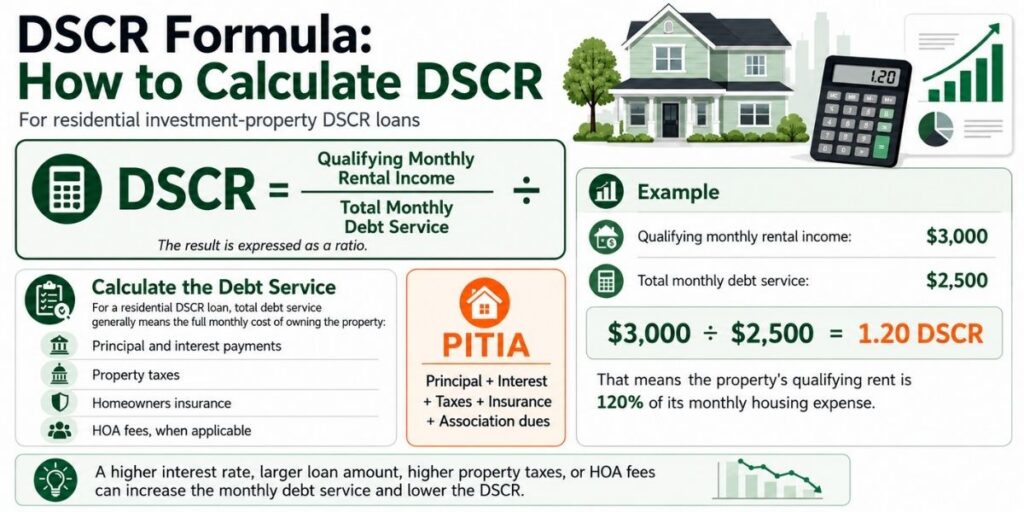
Infographic explaining how to calculate DSCR for residential investment properties: qualifying monthly rental income divided by total monthly debt service, including principal, interest, taxes, insurance, and HOA fees, with a $3,000 rent and $2,500 payment example resulting in a 1.20 DSCR.

Important: This Is Not a Generic NOI Calculation

You may see generic business-finance articles define DSCR as net operating income divided by total debt service. That formula can apply in commercial lending and broader business-finance analysis.

For the residential DSCR loan programs discussed here, however, lenders typically use the property’s qualifying monthly rental income and compare it to the monthly PITIA payment. Do not assume that operating expenses, capital expenditures, property-management costs, vacancy assumptions, or other expenses will be calculated the same way across every loan program.

The lender’s current guideline controls the calculation.

How Rental Income Is Used for DSCR Loans

The rental income used for a DSCR calculation depends on whether the property will be used as a long-term rental or short-term rental.

Long-Term Rental Income

For a long-term rental property, the lender may use:

  • The full monthly rent shown on the current lease or rent roll, or
  • The long-term market rent established in the property appraisal

When a long-term rental is being evaluated, 100% of the eligible rent may be used for the DSCR calculation, subject to the lender’s documentation and appraisal requirements.

Short-Term Rental Income

Short-term rentals require a different approach because monthly income can fluctuate based on occupancy, seasonality, and market demand.

For a short-term rental, lenders commonly use a percentage of the short-term rental income supported by the appraisal. A common approach is to use 75% of the appraised short-term rental income for the DSCR calculation.

For example:

  • Appraised short-term rental income: $5,000 per month
  • Qualifying income at 75%: $3,750 per month
  • Monthly PITIA: $3,000

$3,750 ÷ $3,000 = 1.25 DSCR

The lender will determine which rental-income source is acceptable and how much of that income can be used.

What Is a Good DSCR?

A “good” DSCR depends on the lender, property type, loan program, down payment, credit profile, and current market conditions.

Here is a simple way to understand common DSCR ranges:

DSCR RatioWhat It Generally Means
Below 1.00The property’s qualifying income does not fully cover its monthly debt service.
1.00The property breaks even based on the lender’s calculation.
1.10–1.24The property has some coverage above its monthly debt service.
1.25A strong ratio with a 25% cushion above the monthly payment.
1.50+A very strong cash-flow picture.
2.00The qualifying rental income is twice the monthly debt service.

A DSCR of 1.25 is often viewed as an ideal target because it provides a cushion for the property’s monthly payment. Still, it is important not to present 1.25 as a universal minimum.

Many lenders can work with a DSCR of 1.00 or higher, depending on the program. Some lenders may also offer below-1.00 or no-ratio loan programs. Those loans may involve a larger down payment, higher interest rate, additional reserves, higher overall costs, or other compensating factors.
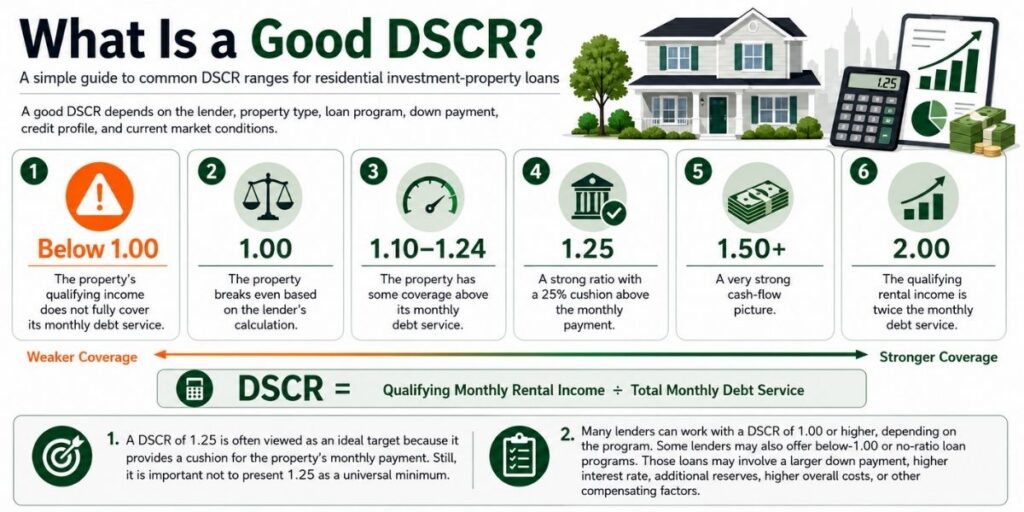
Infographic showing common residential investment-property DSCR ranges, from below 1.00 insufficient coverage to 2.00 strong coverage, and explaining that 1.25 provides a 25% cushion while lender requirements vary by program.

DSCR Loan Calculator: Calculate DSCR Before You Apply

A DSCR calculator can help investors estimate whether a property may qualify before making an offer or applying for financing.

To calculate DSCR, gather these monthly numbers:

  1. Eligible rental income
  2. Principal and interest payment
  3. Property taxes
  4. Homeowners insurance
  5. HOA fees, if applicable

Then use this formula:

Monthly Rental Income ÷ Monthly PITIA = DSCR

DSCR Calculator Example

A long-term rental property has:

  • Monthly lease income: $3,200
  • Principal and interest payment: $1,850
  • Property taxes: $420
  • Homeowners insurance: $160
  • HOA fees: $120

Total monthly debt service:

$1,850 + $420 + $160 + $120 = $2,550

DSCR calculation:

$3,200 ÷ $2,550 = 1.25 DSCR

This property has a 1.25 ratio based on the rental income and monthly housing payment.

A DSCR calculator is helpful for planning, but it is not a loan approval. The final calculation will depend on the lender’s guidelines, appraisal, property taxes, insurance quote, HOA dues, loan terms, and interest rate.

DSCR Loan Requirements for Investment Properties

DSCR loans are designed for non-owner-occupied investment properties.

The borrower must certify that they will not occupy the property as a primary residence or second home. Living in the property would undermine the way the loan is underwritten, because qualification is based on the income the property is expected to generate as a rental.

Common DSCR loan considerations include:

  • Investment-property occupancy only
  • Credit score and credit history
  • Down payment or equity position
  • Cash reserves
  • Property type
  • Rental-income documentation
  • Long-term versus short-term rental strategy
  • Loan amount and loan terms
  • Interest rate and overall costs

A down payment of 20% or more is common for many DSCR loan programs. Most DSCR loans also do not require traditional mortgage insurance, although lenders may have their own loan-to-value, reserve, pricing, and credit requirements.

The Mortgage Architects currently focuses on residential investment-property financing, including smaller multifamily scenarios of roughly 10 units or fewer, subject to available lender guidelines. Larger commercial financing is outside the scope of this guide.

DSCR Loan vs. Traditional Mortgage Qualification

A conventional mortgage usually focuses heavily on the borrower’s personal income, debts, credit profile, and debt-to-income ratio.

A DSCR loan takes a different approach.

Instead of asking whether the borrower’s personal income can cover the mortgage payments, the lender asks whether the property’s rental income can support the property’s monthly debt service.

That does not mean a DSCR loan has no underwriting requirements. Lenders still evaluate the overall risk of the loan. But the DSCR calculation is not the same as a traditional DTI calculation.

This can be useful for investors who:

  • Are self-employed
  • Have complex tax returns
  • Own multiple rental properties
  • Want to qualify based on property cash flow
  • Prefer not to use traditional income documentation as the primary basis for qualification
  • Are purchasing or refinancing a long-term or short-term rental property

What Happens When the DSCR Is Below 1.00?

A DSCR below 1.00 means the property’s qualifying rental income does not fully cover the proposed monthly debt service.

For example:

  • Qualifying monthly rental income: $2,400
  • Monthly PITIA: $2,700

$2,400 ÷ $2,700 = 0.89 DSCR

That property does not support the proposed monthly payment based on the lender’s DSCR calculation.

Possible ways to improve the scenario may include:

  • Making a larger down payment
  • Reducing the loan amount
  • Choosing a different loan term
  • Paying points to reduce the interest rate
  • Refinancing with a different structure
  • Finding a property with stronger rental income
  • Exploring a below-1.00 or no-ratio DSCR program, if available

The best option depends on the investor’s overall goals, the property, and available loan programs.

How The Mortgage Architects Can Help

The Mortgage Architects helps real estate investors look at the financing side before they commit to a purchase, refinance, or portfolio expansion.

We can help you review:

  • Whether the property’s expected rent may support the proposed mortgage loan
  • Long-term versus short-term rental-income options
  • Estimated DSCR based on monthly rent and PITIA
  • How changes in down payment, interest rate, or loan amount may affect cash flow
  • Whether a standard DSCR loan, below-1.00 program, no-ratio option, or another investment loan may fit the property
  • Which documentation may be needed for the lender to review the file

The goal is to help you understand the numbers before you make a move.

Preguntas frecuentes

What does DSCR stand for?

DSCR stands for Debt Service Coverage Ratio. It measures whether a property’s qualifying rental income can cover its total monthly debt service.

What is the DSCR formula?

For a residential DSCR loan, the formula is:
DSCR = Qualifying Monthly Rental Income ÷ Monthly PITIA
PITIA includes principal, interest, property taxes, homeowners insurance, and applicable HOA fees.

Can I live in a property financed with a DSCR loan?

No. The DSCR loans discussed here are for investment properties only. Borrowers must certify that they will not occupy the property as a primary residence or second home.

Is a DSCR of 1.00 good?

A DSCR of 1.00 means the property’s qualifying rent equals its monthly debt service. It is a break-even ratio with no additional cushion. Some lenders may approve a 1.00 ratio, while others may prefer a higher minimum DSCR.

Is 1.25 required for every DSCR loan?

No. A DSCR of 1.25 is a strong benchmark, but lender requirements vary. Many lenders can work with a 1.00 ratio or better, and some programs allow lower or no-ratio options with different pricing and requirements.

How is long-term rental income calculated?

For long-term rentals, lenders may use the current lease or rent roll, or market rent supported by the appraisal. Eligible long-term rental income may be used at 100%, depending on lender guidelines.

How is short-term rental income calculated?

For short-term rentals, lenders commonly use a percentage of the rental income supported by the appraisal. A common guideline is to use 75% of the appraised short-term rental income.

Do DSCR loans require tax returns or W-2 income?

Many DSCR loan programs focus primarily on the property’s rental income instead of traditional borrower income documentation. Lenders may still review credit, reserves, assets, property details, and other underwriting factors.

Do DSCR loans require mortgage insurance?

Most DSCR loan programs do not use traditional mortgage insurance. However, borrowers should expect lender requirements around down payment, reserves, credit, loan-to-value, interest rate, and overall costs.

Is DSCR the same as debt-to-income ratio?

No. Debt-to-income ratio compares a borrower’s personal income to personal debt payments. DSCR compares a property’s qualifying rental income to the property’s monthly debt service.

This article is for general educational purposes only and is not a loan approval, commitment, or guarantee of financing. Loan programs, interest rates, costs, property eligibility, rental-income treatment, and minimum DSCR requirements vary by lender and may change.

Mortgage broker weighing pros and cons of locking a mortgage rate with home and market graphics.

Why Lock Your Loan? Risks & Benefits of Locking Your Mortgage Rate Explained

Should I lock it or not? Many homebuyers are stuck in “analysis paralysis,” debating whether to lock their rate or wait for potential improvements. However, delaying your rate lock can cost you thousands of dollars. Understanding your risk tolerance is key when deciding whether to secure a locked in rate during the mortgage process.

In this guide, we’ll break down:
✅ Why locking your rate is crucial
✅ The risks of waiting
✅ How lenders price mortgage rates
✅ Ways to mitigate losses if rates improve

Let’s dive in!


What is a Mortgage Rate Lock?

A mortgage rate lock is an agreement between you and your lender that ensures your interest rate won’t change for a specified period—typically 30, 45, or 60 days. A locked in rate protects you from rising interest rates during the loan process.

Why does this matter? Because mortgage rates fluctuate daily based on economic factors, market conditions, and Federal Reserve policies. Locking your rate safeguards you from unexpected increases. It’s important to review your rate lock agreement for specific terms, including any fees or options.


The Risks of Not Locking Your Rate

1. Market Volatility Can Cost You Thousands

Mortgage-backed securities (MBS) determine interest rates, and they behave like the stock market—constantly moving.

  • Green means good (rates drop, loans become cheaper).
  • Red means bad (rates increase, making your mortgage more expensive).

Even waiting just a few weeks can lead to significant changes in rates, especially for a purchase mortgage where timing is critical to secure the best possible rate before closing.

Some days, rates fluctuate dramatically. If you delay locking in your rate and the market shifts overnight, your mortgage payment could become significantly more expensive.

💡 Example:
Let’s say you’re financing a $500,000 home with an interest rate of 6.5% at no additional cost. If the market worsens the next day and that same rate now costs $2,500 upfront, you’ve just lost out by waiting.

2. Waiting for Lower Rates is a Gamble

Some buyers try to “time the market,” hoping rates will drop before they lock in. The problem? The mortgage market is unpredictable.

  • Lenders hedge their risk by pricing rates conservatively.
  • Even if rates drop slightly, lenders won’t pass all those savings on to you.
  • A worsening market can drive rates up significantly in just one day.

🏠 Key takeaway: It’s better to lock in a solid rate now than risk a sudden increase.


Why Lenders Always Win in Rate Pricing

Mortgage lenders operate like a casino—the odds favor them. Here’s how:

1. Downward Market = Higher Costs for You

If rates rise, lenders increase pricing quickly to protect their profits. You, the borrower, bear the cost.

2. Upward Market = Minimal Savings Passed to You

If rates drop, lenders adjust pricing slowly, ensuring they still benefit.

📊 Bottom line: Lenders position themselves to minimize their risk. You should too—by locking in your rate.


How to Mitigate the Risk of a Rate Drop After Locking

Some buyers worry about locking too early—what if rates improve? Here’s the good news:

✔️ Switching Lenders – If a better rate becomes available, an independent mortgage broker (like us!) can move your loan to another lender with better pricing.

✔️ Rate Renegotiation – Some lenders allow a one-time “float down” option to lower your rate if the market shifts favorably.

✔️ Loan Pricing Adjustments – Once locked, you can still adjust the loan structure (paying points for a lower rate or taking lender credits for closing cost savings).


Loan Amount & Rate Changes: How Much Does It Matter?

The bigger your loan, the greater the impact of interest rate fluctuations.

🔢 Example Calculation:

  • Loan Amount: $500,000
  • Interest Rate: 6.5%
  • Cost for that rate: 0.5 points (0.5% of the loan)
  • Total Cost: $500,000 × 0.005 = $2,500

💰 A 1% rate increase on a $700,000 loan could cost you over $7,000 upfront or hundreds per month.


The Overnight Rate Change Scenario

📅 Day 1: You’re under contract, and your lender provides rate options.

🔄 Day 2: You decide to wait… but the market shifts.

🚨 Result:

  • That 6.5% rate is no longer free—it now costs $2,500+ upfront.
  • Your payment increases, or you pay thousands extra at closing.

😟 Avoid this mistake—lock your rate when given the opportunity!


Key Takeaways: How to Make the Right Decision

Lock your rate early – Market volatility can cost you significantly overnight.
Don’t wait for a perfect rate – Trying to time the market is risky.
Lenders always hedge their risk – Protect yourself by securing a rate.
Loan size matters – The larger your loan, the bigger the impact of changes.
You can still switch lenders – An independent mortgage broker can help you find the best rate after locking.

📣 Ready to secure your rate and protect your finances? Contact us today for expert guidance!


Would you like a shorter version of this article or a social media post for platforms like Instagram, LinkedIn, and TikTok? Let me know, and I’ll tailor the content for different audiences! 🚀

You said:

Can you write an FAQ for this article?

ChatGPT said:

FAQ: Mortgage Rate Locks – Everything You Need to Know

1. What is a mortgage rate lock?

A mortgage rate lock is an agreement between you and your lender that secures a specific interest rate for a set period (usually 30, 45, or 60 days). This ensures that your rate won’t change due to market fluctuations while your loan is being processed.

2. Why should I lock my mortgage rate?

Locking your rate protects you from unexpected interest rate increases. Mortgage rates fluctuate daily based on economic news, inflation, and market conditions. If you don’t lock, your rate could go up overnight, costing you thousands more over the life of your loan.

3. When should I lock my mortgage rate?

You should lock your mortgage rate as soon as you are comfortable with the rate being offered and are under contract for a home. The longer you wait, the more you risk market volatility increasing your rate.

4. What happens if I don’t lock my rate?

If you don’t lock your rate and the market shifts, your mortgage could become significantly more expensive. A rate increase of just 0.5% could cost you thousands in upfront fees or increase your monthly payment by hundreds of dollars.

5. Can I wait for rates to improve before locking?

You can, but it’s risky. Mortgage markets are unpredictable, and lenders adjust rates quickly to protect themselves. If rates do drop, lenders may not pass all the savings to you. If rates go up, you’ll be stuck paying more.

6. What if I lock my rate and then rates go down?

If rates drop significantly after you lock, you may have options:

  • Rate renegotiation (float-down option): Some lenders allow a one-time adjustment if market conditions improve.
  • Switching lenders: If a different lender offers a better rate, an independent mortgage broker can move your loan.
  • Loan structure changes: You may be able to adjust your loan terms to take advantage of lower rates.

7. How do lenders decide mortgage interest rates?

Mortgage rates are based on the movement of mortgage-backed securities (MBS) in the financial markets. When MBS prices rise, rates decrease, and when MBS prices drop, rates increase. Other factors influencing rates include inflation, Federal Reserve policies, and global economic conditions.

8. What does it mean when people say ‘floating’ a mortgage rate?

Floating means choosing not to lock your rate and waiting to see if the market improves. This is risky because if rates increase, you’ll be stuck paying more. Locking eliminates this uncertainty.

9. Does locking my rate cost anything?

Rate locks typically do not have a direct cost unless you choose a longer lock period (e.g., 90 days). However, delaying a lock and seeing rates increase can result in higher costs in the form of higher interest rates or upfront fees (points).

10. What is ‘par pricing,’ and why does it matter?

Par pricing means you’re getting a rate with no extra cost to you. If a lender quotes you a 6.5% interest rate at par pricing, it means you aren’t paying extra fees (points) to get that rate. However, if the market worsens overnight, the same rate may now cost thousands upfront.

11. What are mortgage points, and how do they affect my loan?

Mortgage points (discount points) are fees paid upfront to lower your interest rate. One point equals 1% of your loan amount. For example, on a $500,000 loan:

  • 0.5 points = $2,500 upfront
  • 1 point = $5,000 upfront

If the market shifts overnight, you may have to pay more points to keep the same rate.

12. What if I lock my rate but my closing is delayed?

If your closing takes longer than your rate lock period, you may need a rate lock extension. Some lenders charge for this, while others offer a free extension under certain conditions.

13. Can I change my mortgage rate after locking?

Yes, but with limitations. Once locked, your entire rate sheet is locked. You can still adjust within those options (choosing a slightly higher or lower rate with different pricing), but you can’t access new rates that came after your lock date.

14. Does my loan amount affect how much rates impact me?

Yes! The larger your loan, the bigger the financial impact of rate changes. For example, a 0.5% increase on a $700,000 loan is far more costly than the same increase on a $200,000 loan.

15. What if I lock my rate and then change lenders?

If you work with an independent mortgage broker, they can move your loan to a different lender if a better rate becomes available. This is a major advantage of working with a broker versus a bank.

16. Is there ever a reason NOT to lock my mortgage rate?

Very rarely. The only time you might hold off on locking is if you have strong insider knowledge that rates will drop significantly in the short term and you can afford to take the risk. For most buyers, locking as soon as possible is the best choice.

17. Can I lock my rate before I find a home?

Some lenders offer “lock and shop” programs that let you secure a rate before you have a property under contract. This can be useful in rising rate environments.

18. What’s the difference between a broker and a bank when locking rates?

  • Banks only offer their own loan products, so you’re stuck with their rates.
  • Brokers have access to multiple lenders (sometimes 50+), giving you flexibility to switch if rates improve elsewhere.

19. Can I break my rate lock if I change my mind?

Generally, no. Once you lock, you’re committed unless you switch lenders or pay a penalty (if applicable). However, a broker can help you explore alternative lenders if needed.

20. What’s the biggest mistake homebuyers make with rate locks?

The biggest mistake is waiting too long and missing a good rate. Rates can change overnight, and once they increase, there’s no way to go back. Locking early protects you from unnecessary financial risk.


Final Takeaway: Locking your mortgage rate early is the best way to protect yourself from market uncertainty. If you have more questions or need expert guidance, reach out today!

Self-employed mortgage graphic highlighting critical tax filing information with Schedule C form and mortgage broker pointing.

Self-Employed Tax Prep Causing Mortgage Hurdles?

When it comes to obtaining a mortgage as a self-employed individual, understanding how your taxes impact your loan approval is crucial.

Nathan Jennison of Mortgage Architects shares insights into why proper tax planning is essential if you’re looking to purchase a home or refinance in the next two years. Here’s everything you need to know to set yourself up for success.


Why Self-Employed Borrowers Face Unique Challenges

Unlike W-2 employees, whose income is considered stable and easy to calculate, self-employed individuals encounter additional scrutiny. The reason? Lenders often perceive self-employed income as less predictable.

However, there’s a major advantage: as a business owner, you can actively influence your income levels through strategic decisions, which can lead to higher loan approval amounts. But this flexibility comes with trade-offs.

If the planned loan amount may exceed the local threshold, review the county’s conforming loan limit early so jumbo-program income and reserve requirements can be considered before filing.


The Tax Dilemma for Self-Employed Individuals

As self-employed professionals, many of us aim to minimize our tax liability by maximizing deductions and hiring CPAs to optimize our tax strategy. While this approach reduces taxes owed, it also lowers the income that lenders consider when determining mortgage eligibility. Here’s why this is a problem:

  • Lender Criteria: Mortgage approvals are based on taxable income. The more you write off, the less income is “visible” to lenders.
  • Long-Term Impact: Excessive write-offs can limit your borrowing capacity, making it harder to qualify for the home you want.

The Importance of Sending Tax Drafts

Jennison emphasizes the importance of sending your tax drafts to your mortgage advisor before filing them. This step allows for a thorough review to ensure you’re balancing tax savings with income visibility for loan purposes. Here’s the process:

  1. Draft Review: Submit your tax drafts before finalizing them.
  2. Recommendations: Your mortgage advisor will analyze the numbers, identify areas for improvement, and make suggestions to align your taxes with your mortgage goals.
  3. Approval Planning: By optimizing your taxable income, you can enhance your chances of mortgage approval.

Key Considerations for Self-Employed Mortgage Applicants

1. Understanding Depreciation

Depreciation is a critical factor for self-employed individuals. While the IRS treats depreciation as a business loss, mortgage lenders add it back to your income during their calculations. This adjustment can significantly improve your approvable income.

Example:

  • In 2022, a business reported $5,000 in depreciation.
  • In 2023, that number jumped to $45,000.
  • For IRS purposes, this reduces taxable income, but for lenders, it boosts approvable income.

2. Year-to-Year Income Trends

Lenders also examine your income stability over the past two years. Declining income may raise red flags, but with proper documentation and explanation (like high depreciation in a specific year), you can present a stronger case.

3. Averaging Income

Typically, lenders average your income over two years to determine your eligibility. For instance:

  • 2022 Approveable Income: $187,000
  • 2023 Approveable Income: $200,000
  • Average Monthly Income: $16,128

For businesses with stable income over five or more years, lenders may consider using just one year of tax returns, offering greater flexibility.


How to Optimize Your Mortgage Readiness

To ensure your finances are in top shape for mortgage approval, follow these steps:

  • Plan Ahead: Start tax planning at least two years before applying for a mortgage.
  • Seek Professional Advice: Work with a mortgage broker and CPA who understand the nuances of self-employment and mortgages.
  • Maintain Consistency: Avoid drastic changes in income that may alarm lenders.
  • Track Depreciation: Use depreciation to your advantage by understanding how it impacts your approvable income.

FAQs About Mortgages for Self-Employed Individuals

Q: Can I still qualify for a mortgage if I maximize deductions?

Yes, but it depends on how your deductions impact your taxable income. Sending your tax drafts for review can help you strike a balance.

Q: How far back will lenders look at my income?

Typically, lenders review the past two years of tax returns, though some exceptions allow for just one year.

Q: What documents do I need to provide?

Be prepared to share:

  • Two years of tax returns (or one year if eligible)
  • Profit and loss statements
  • Business bank statements
  • Proof of business stability

Take Control of Your Mortgage Future

As a self-employed individual, your tax strategy can make or break your mortgage application. By sending your tax drafts for review, you’ll gain expert insights into how to optimize your financial position and increase your chances of approval. Remember, proactive planning is key to securing the loan you need.

If you have any questions or need personalized advice, don’t hesitate to reach out. Your mortgage success story starts with smart tax planning today!

How to spot a bad refinance graphic showing a mortgage broker reacting to locked cash on fire, warning against costly refinancing mistakes.

Bad Refinance? How to Avoid Costly Mistakes and Save Money

Bad refinance deals can cost homeowners tens of thousands of dollars, often without them realizing it until it’s too late. These types of refinancing strategies may seem attractive at first, offering lower interest rates and reduced monthly payments, but the hidden costs can significantly outweigh the benefits. In this guide, we’ll explore what makes a refinance “bad,” how to spot these pitfalls, and strategies to refinance smarter while saving money.

What Is a Bad Refinance?

A bad refinance occurs when a borrower is offered a lower interest rate on their mortgage but ends up paying exorbitant upfront fees—often without realizing it. These fees, typically labeled as “points” or “origination charges,” can add up to tens of thousands of dollars. While the allure of a lower monthly payment is tempting, the long-term financial impact can be detrimental.


A Real-World Example of a Bad Refinance

Let’s examine a typical bad refinance scenario:

  • Current Loan Details:
    • Loan amount: $400,000
    • Interest rate: 7%
  • Refinanced Loan Details:
    • Loan amount: $400,000
    • Interest rate: 5.625%

At first glance, this refinance looks fantastic because it reduces the borrower’s monthly payment by $378. However, upon closer inspection, the borrower is paying $16,000 in points to secure that lower interest rate. Since most borrowers don’t have $16,000 in cash, lenders roll this amount into the loan, increasing the loan amount to $416,000.

The result? The borrower is still $3,300 in the hole after 24 months due to the upfront costs. Worse, it takes 80 months (over 6.5 years) to break even on this refinance. This lengthy break-even period negates the financial benefits, especially when interest rates might drop again within that time frame.


Smarter Alternatives to Refinancing

Now that we’ve highlighted the dangers of a bad refinance, let’s explore better refinancing strategies that save you money in the short and long term.

1. Lender-Paid Origination

In a lender-paid origination refinance, the lender covers the loan origination fees, not the borrower. Here’s how it works:

  • The borrower refinances a $400,000 loan at 6.5% (instead of 5.625%).
  • Monthly savings: $152.
  • Total cost: $7,400.

While the savings are smaller than the bad refinance example, the upfront costs are significantly reduced, making this a much safer and more affordable option.


2. Borrower-Paid Origination with Discounts

This method offers even greater flexibility. Instead of the lender covering the fees, the borrower pays them—but with substantial discounts.

  • Loan amount: $400,000.
  • Interest rate: 6.125%.
  • Monthly savings: $250.
  • Upfront cost: $3,000 (a fraction of the $16,000 in the bad refinance example).

Because the upfront costs are minimal, borrowers typically break even within just 24 months and begin seeing real savings. Additionally, a portion of the upfront cost is often refunded via the escrow account, further reducing the out-of-pocket expense.


3. Refinancing Strategically Over Time

Interest rates are cyclical, and history shows they will likely drop again in the future. A smart refinancing strategy allows you to:

  • Minimize upfront costs with each refinance.
  • Follow interest rates down over time.
  • Avoid locking into a refinance with a long break-even period.

This method ensures you consistently benefit from falling rates without losing ground on paying off your mortgage.


Why Timing Matters: Following Interest Rates Down

Mortgage rates are currently elevated, resembling levels last seen in 2009. However, economists predict rates will decline over the next 1–2 years—though they may not return to the historic lows of 2020. By avoiding costly upfront fees, you’ll be better positioned to refinance again as rates drop.


Key Takeaways for Avoiding a Bad Refinance

  1. Always Review Loan Estimates Carefully: Pay close attention to the “Loan Costs – Section A” on your loan estimate. High origination charges or points are red flags.
  2. Calculate Your Break-Even Period: Divide the total upfront cost by your monthly savings to determine how long it will take to recoup your investment. Avoid refinances with a break-even period longer than 24–36 months.
  3. Work with a Trusted Loan Officer: A good loan officer will prioritize your financial well-being, helping you choose a refinancing strategy that aligns with your goals.
  4. Stay Flexible: Avoid locking into refinances that prevent you from taking advantage of future rate drops.

Why Work With Us?

At Mortgage Architects, our mission is to help you avoid costly mistakes and maximize your financial opportunities. When you refinance with us, we’ll:

  • Analyze your current financial situation.
  • Set a target interest rate based on market trends.
  • Develop a refinancing strategy that minimizes costs and maximizes savings.

By working with us, you’ll enjoy peace of mind knowing your mortgage is in expert hands.


Make the Right Refinancing Choice

Refinancing can be a powerful tool to reduce your monthly payments and save money—but only if done correctly. Avoid the pitfalls of bad refinances by working with a loan officer who prioritizes transparency and long-term savings.

If you’re considering refinancing, give us a call. Together, we’ll assess your options, set a realistic target rate, and create a strategy to make the most of every rate drop.